
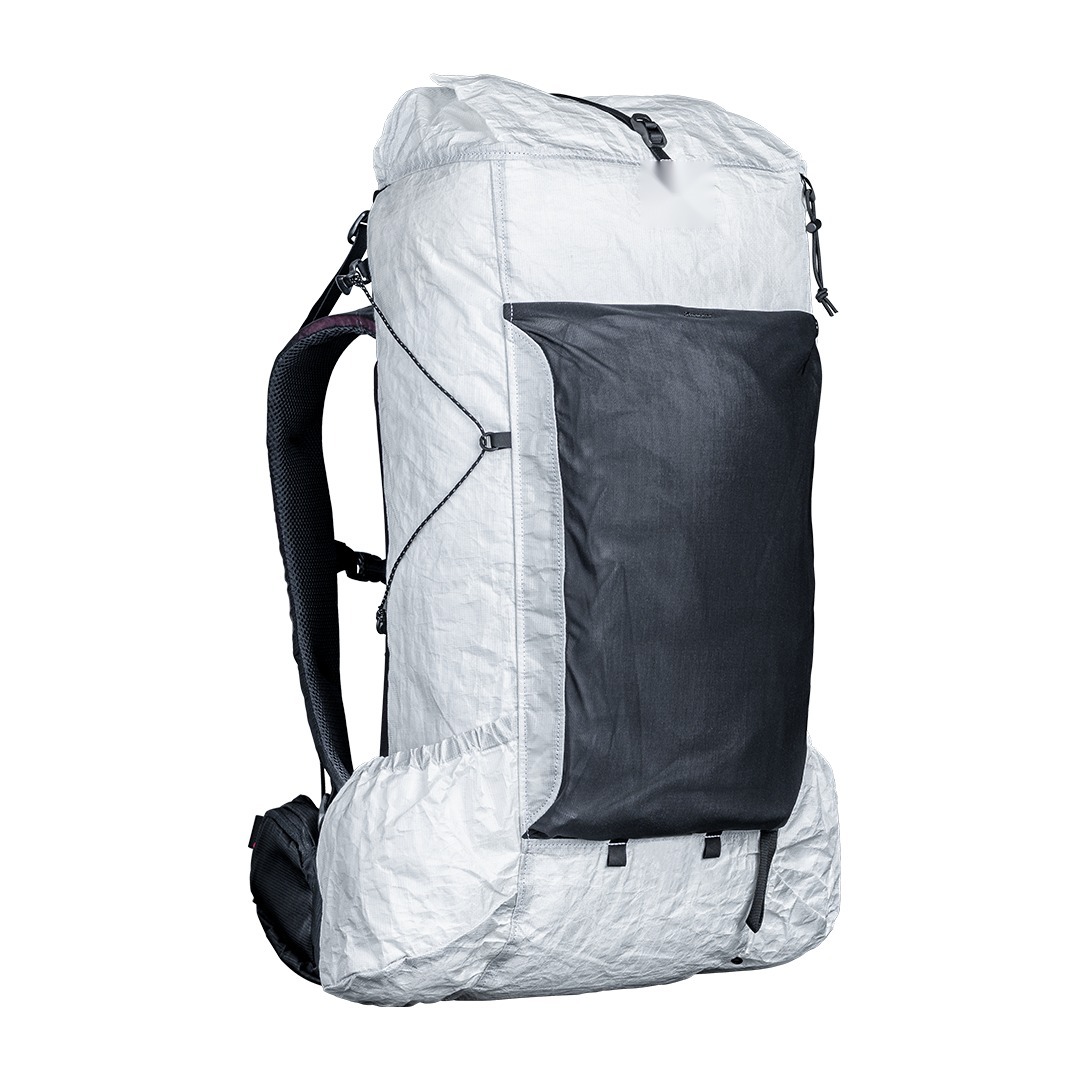
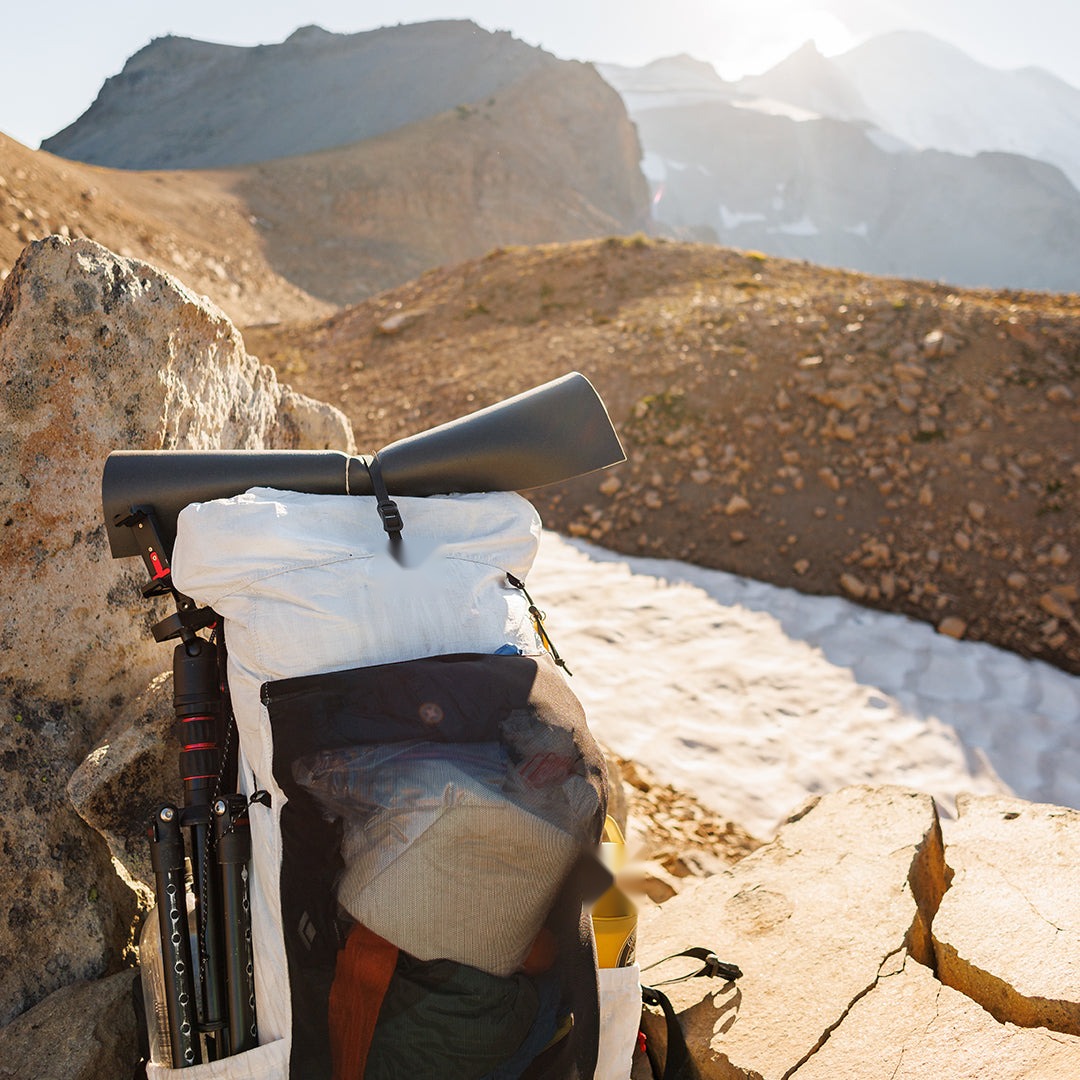
A frameless pack avoids frame weight, while a framed pack gives a taller load more structure. This example uses two pre-bent carbon-fibre stays and a woven UHMWPE and polyester shell.
This 51–53-litre reference design pairs vertical stays with a padded hip belt and large external pockets. It is not a JKPD product.
01
At a glance
| Feature | S | M/L |
|---|---|---|
| Volume | 51 L | 53 L |
| Volume split | 39 L main compartment + 2 L + 2 L side pockets + 6 L stretch pocket + 1 L + 1 L hip-belt pockets | 41 L main compartment, same pockets |
| Dimensions | 54.6 cm tall (+ 26.7 cm roll-top) × 27.3 × 17.1 cm | 61 cm tall (+ 26.7 cm roll-top) × 27.3 × 17.1 cm |
| Frame | Two pre-bent carbon-fibre stays | Same |
| Main fabric | Woven UHMWPE and high-tenacity polyester blend with a waterproof film | Same |
| Hip-belt fabric | 100-denier high-tenacity nylon diamond ripstop | Same |
02
Why this pack matters: a frame that weighs almost nothing
The two carbon-fibre stays follow the shape of the back panel. They extend toward the load-lifter attachment, giving the upper straps a firm point to pull against.
The stays are intended to hold the back-panel shape and let the load lifters draw the top of the pack toward the shoulders. Assess frame deflection and attachment on a loaded sample; the material alone does not establish a rating.
There is a limit to what two vertical stays can do. They give the pack rigidity from top to bottom, but they give it no lateral rigidity: if the pack is stuffed full and wide, it can barrel — bulge outwards at the sides. That is a known caveat of the design, and it is worth packing with that in mind.
03
Functions and features
The carbon stays and the load lifters
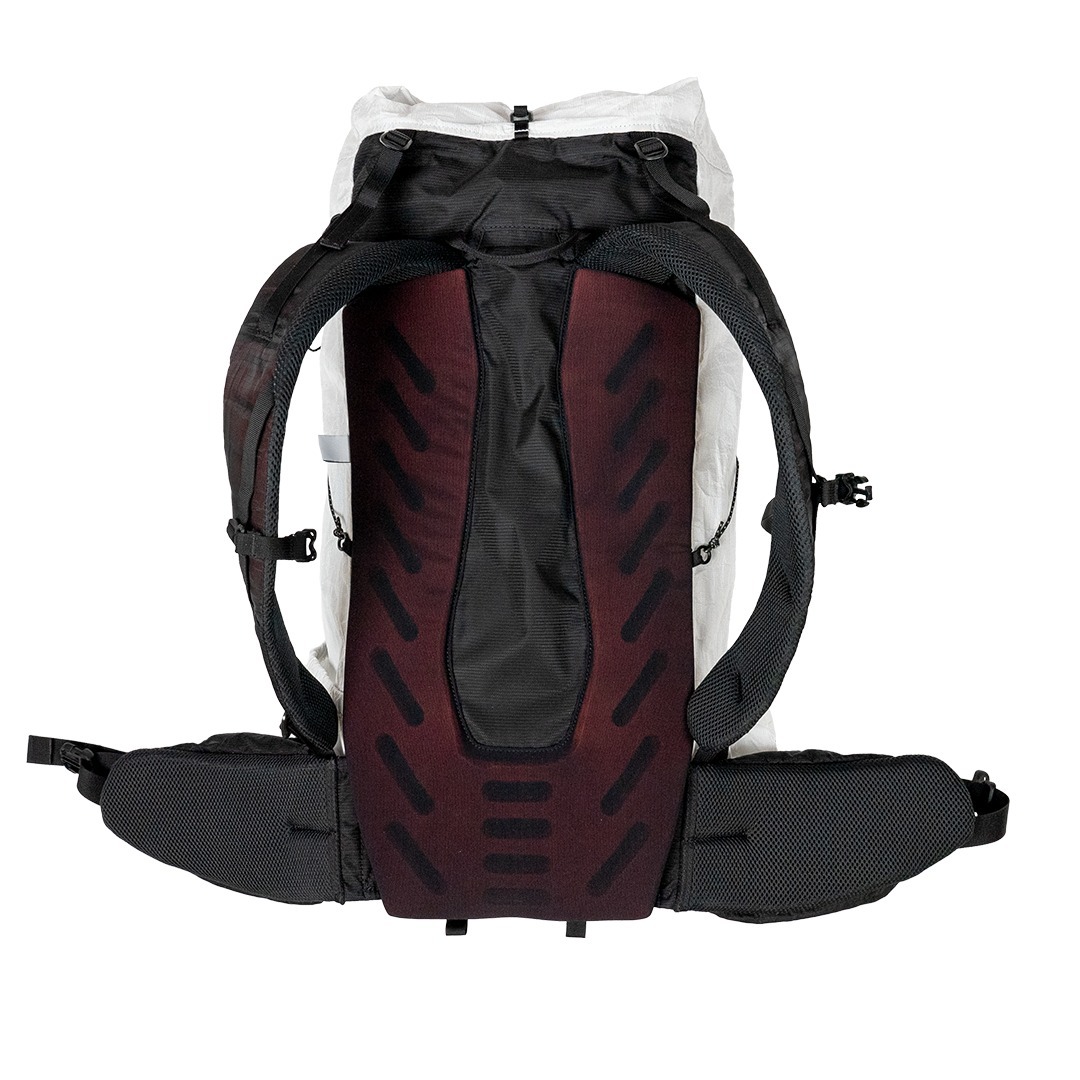
The two stays slot into pockets in the back panel, shielded by a horseshoe-shaped foam pad. Because they extend above the shoulder straps, the load lifters anchor to something rigid: tightening them pulls the load in, rather than just pulling on fabric. That is the difference between a frame that works and a frame that is decorative.
Roll-top closure and generous volume
The pack closes with a roll-top and separates main-compartment volume from storage in the side, front and hip-belt pockets. Confirm the volume breakdown with the collar rolled to its intended position.
That split is useful for planning. The main compartment takes the sleeping system, food and clothing; the pockets take water, rain gear and the small things. A large bear canister fits vertically inside the main compartment, which matters on trails where canisters are required.
Perforated foam throughout the harness
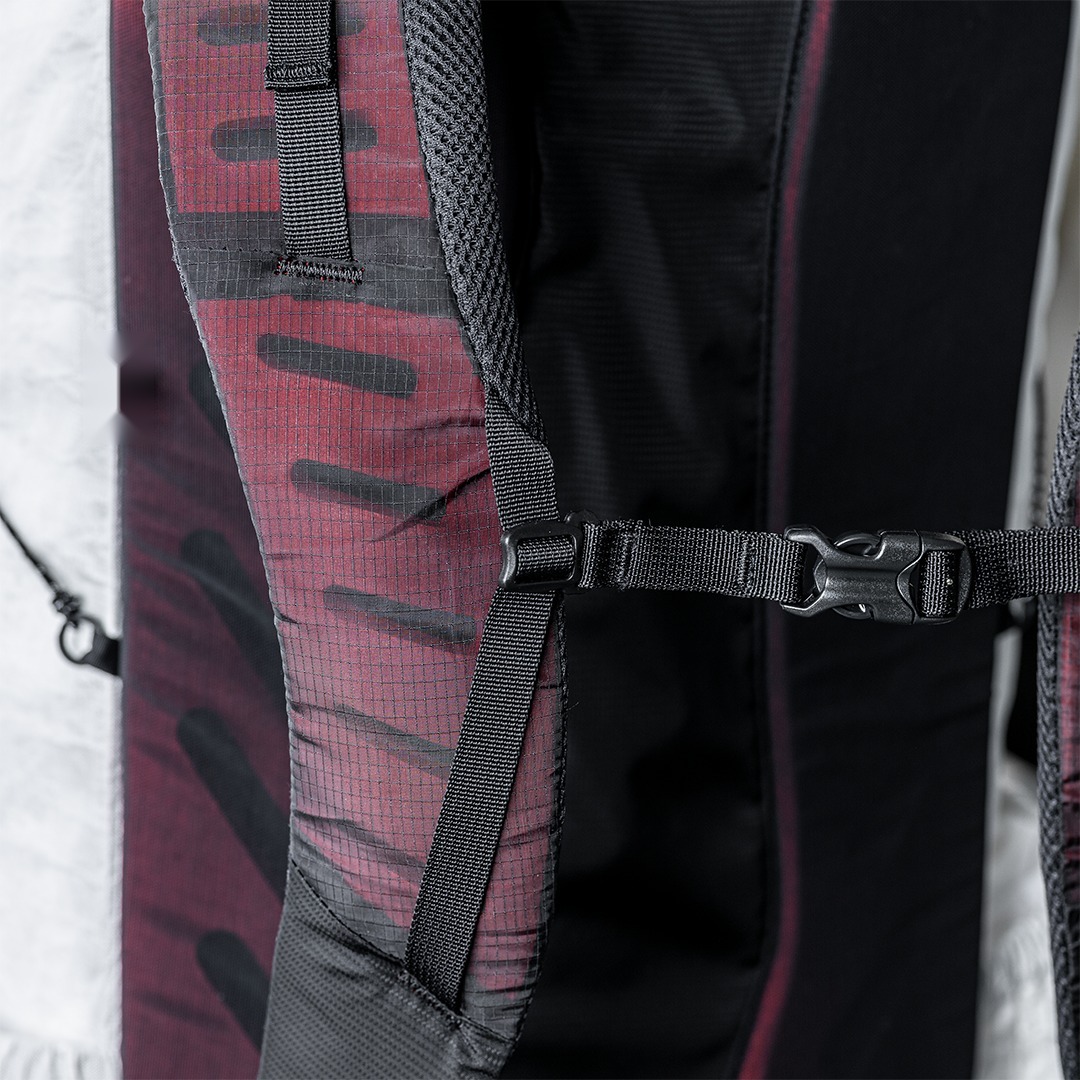
Weight is saved in the harness by cutting holes in the foam rather than by removing padding. The shoulder straps, the back panel and the hip belt all use foam with targeted cut-outs: padding stays where the body needs it, and is removed where it does not. The back panel is a U-shaped pad with cut-outs, and the shoulder straps use the same approach.
The hip belt is wide and fully padded, and it is the part of the pack that carries most of the weight once the load lifters are set. It has two zippered pockets, one with a lanyard clip inside for keys. Four lashing loops on the bottom panel, three-point side compression cords and a top compression strap give options for strapping a sleeping pad or other gear to the outside.
Large angled side pockets
Angled side pockets make room for large bottles and aim to keep them within reach without removing the pack. Check retention with the actual bottle shape and the adjacent pocket loaded.
External loops hold folded poles or other long gear; a rear sleeve and hose port leave another option for hydration.
04
Fabric and material combinations
The main shell uses a woven blend with a laminated film.
- Main body: woven UHMWPE and high-tenacity polyester, laminated with a waterproof film. Verify wear, seam behaviour and bond durability on sample material rather than inferring them from the fibre blend.
- Hip belt: 100-denier high-tenacity nylon diamond ripstop, chosen for abrasion resistance where the belt rubs against the body and the pack.
- Pockets: stretch mesh for the front pocket, keeping weight down and letting wet items drain.
- Frame: two pre-bent carbon-fibre stays, 2 ounces combined.
- Hardware: zips and buckles from specialist suppliers rather than generic parts.
The shell film and the finished seams do different jobs. The seams are sewn rather than taped, and a drain opening sits at the bottom. Use a liner when the contents need separate protection in sustained rain.
05
Who is it for?
- Long-distance hikers who want to retain a frame for changing food and water loads.
- Hikers moving from a conventional pack to ultralight, who want to cut weight without giving up a frame, load lifters and a real hip belt.
- Hikers in dry regions, where carrying several litres of water is unavoidable and large side pockets matter.
- Hikers who carry a bear canister, since a large canister fits vertically in the main compartment.
- Weekend backpackers who like durable gear, who will value a fabric that resists abrasion and a frame that holds its shape.
06
Pain points it solves
- A load that settles on the shoulders. Twin stays and load lifters help maintain the shape of the harness so a well-fitted belt can share the load.
- Shell wear. Evaluate the woven blend where the pack contacts rocks, straps and hard contents.
- Not enough water capacity. Each side pocket takes two litre bottles, plus the front pocket and a hydration sleeve.
- Roll-top packs that are hard to organise. The volume split between the main compartment, side pockets, front pocket and hip-belt pockets keeps small things out of the main compartment.
07
Design strengths
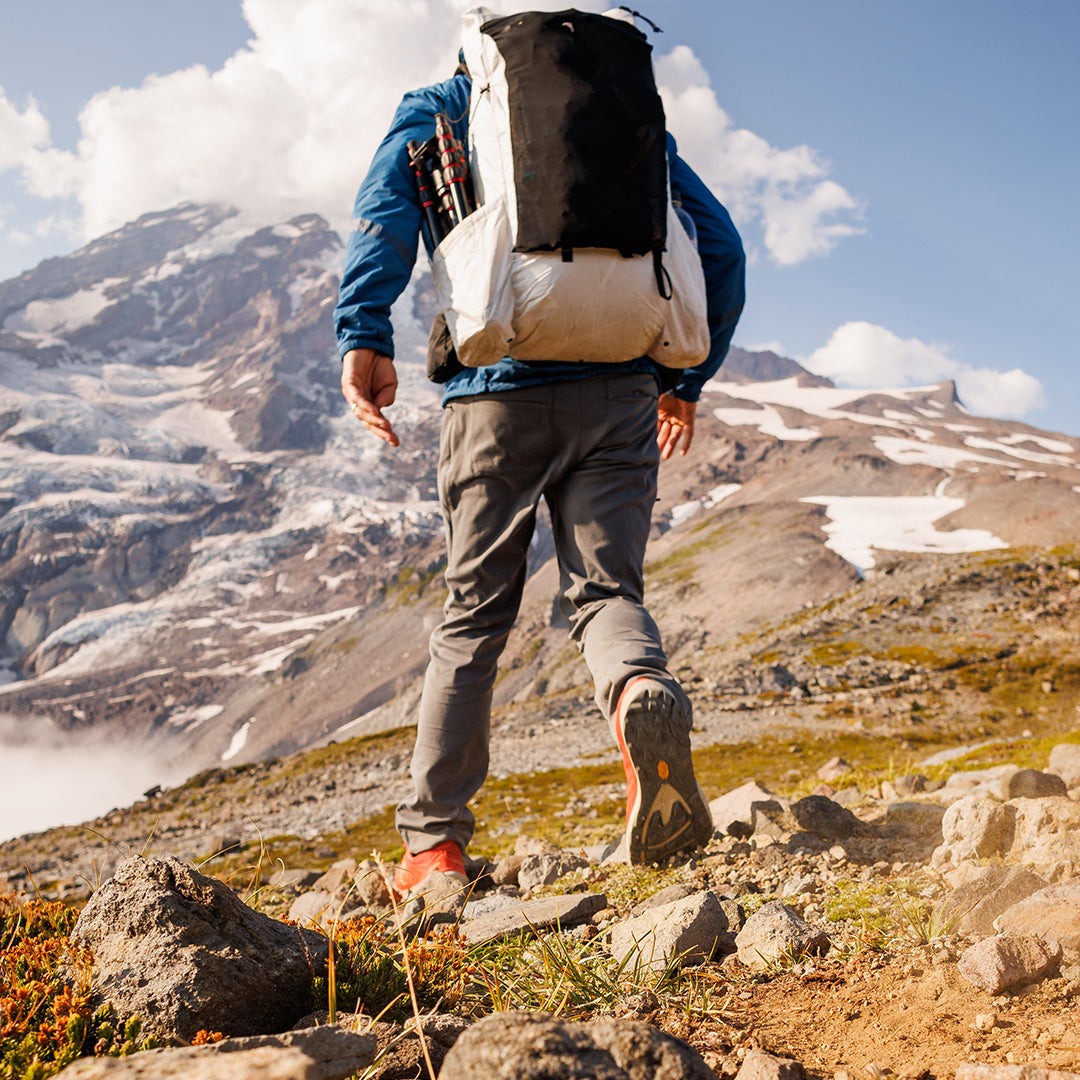
- A light framed layout with two vertical stays and a padded belt.
- A woven UHMWPE and polyester shell with a film layer; verify wear on the intended material.
- Two pre-bent carbon stays running up the back panel toward the load lifters.
- Large angled side pockets, each holding two litre bottles.
- Roll-top closure with a generous volume split, and room for a large bear canister.
- Perforated foam throughout the harness, saving weight while keeping padding where it counts.
- Specialist zips and buckles, and a wide padded hip belt with two zippered pockets.
08
Limitations to keep in mind
- Not fully waterproof. The fabric is waterproof but the seams are sewn, not taped, so a liner is needed in sustained rain.
- No lateral rigidity. Twin vertical stays give stiffness top to bottom but not side to side; the pack can barrel if stuffed full and wide.
- Mesh pockets are less durable than fabric. Stretch mesh saves weight and drains well but can snag on branches and rock.
09
What the design teaches
The main lesson is the connection: the stay, holder, load lifter and belt have to work together. Check for movement at each interface before reducing frame weight.
The shell is a woven blend with a film layer. Compare abrasion and seam behaviour on the actual sample; the finish of the fabric does not make the sewn bag waterproof.
A light long-trail pack is useful when its support continues to work after the carried load changes. Compare a full resupply load with a partly empty sample using the same adjustment marks.
10
Prototype brief
Useful inputs for a carbon-stay pack prototype include:
- Target weight, capacity and recommended maximum load.
- Frame design: stay material and shape, how the stays sit in the back panel, and how the load lifters connect to them.
- Fabric by zone: woven UHMWPE-blend weights for the body, nylon ripstop for the hip belt, and the water-resistance target — including whether seams should be taped.
- Closure and access: roll-top volume, and the split between the main compartment and the pockets.
- Pocket layout: side pocket size for large bottles, front mesh pocket, hip-belt pockets, and hydration options.
- Sizing: torso lengths and hip-belt sizes, and which sizes the line should cover.
Related guide: Hiking Pack Load Lifters: Start with Anchor Geometry
Discuss your bag development project
ANSON XIE
General Manager & Founder
Quanzhou Junkai Pengda Special Equipment Co., Ltd.
Email: ansonxie@jkpdtime.com
Phone: +86 177 5095 3355
WhatsApp: +86 177 5095 3355
Factory address: Floors 2–4, Building 1, Phase I, Huixin Intelligent Manufacturing Industrial Park, Hui'an County, Quanzhou, Fujian, China