
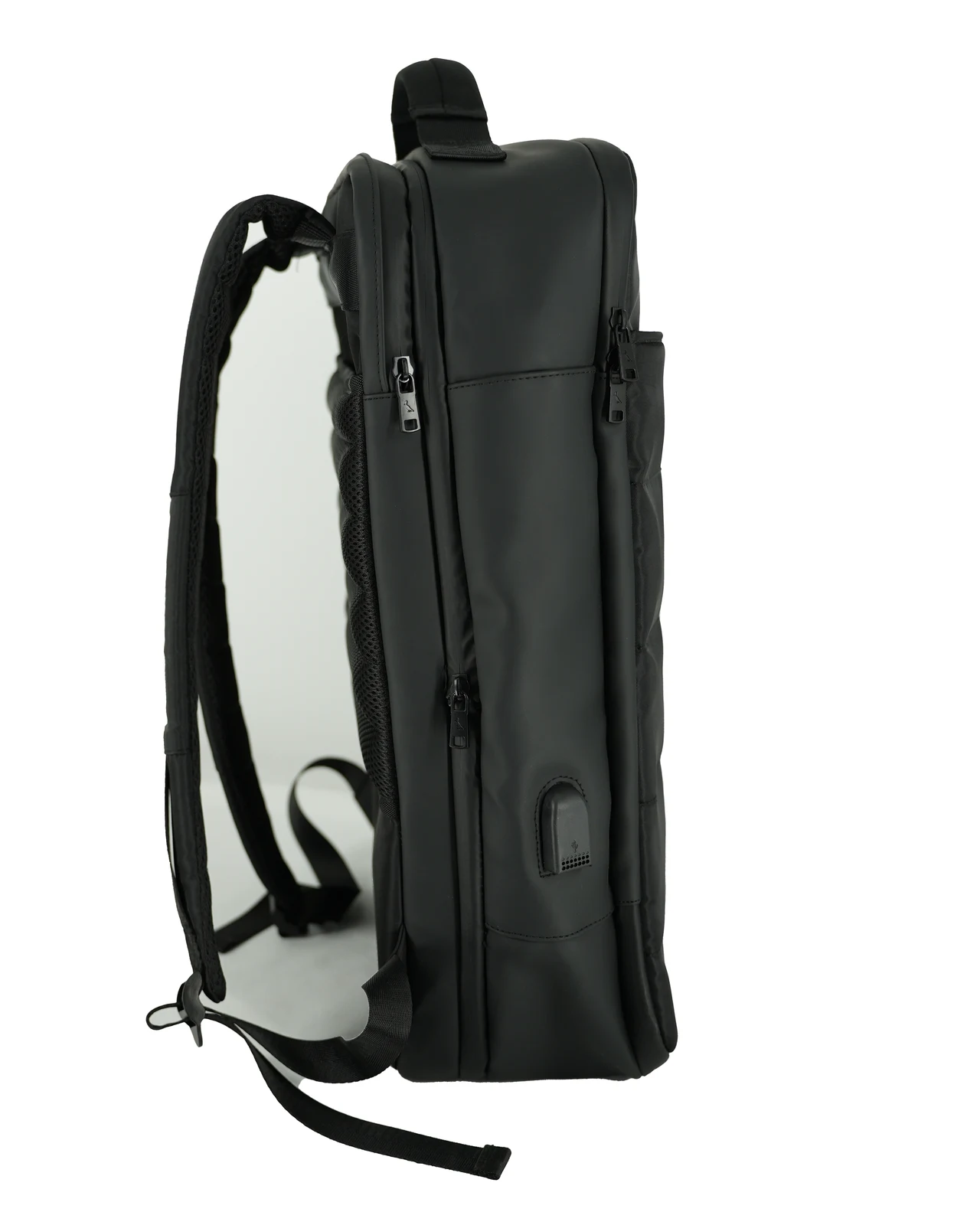
When a business backpack also carries clothing for an overnight trip, the filled lid can consume space that seemed available in the main compartment. Reserve a continuous area for the clothing group, keep office accessories in positions suited to their thickness and allow for separately packing used clothing on the return journey.
Overnight describes a use situation, not a fixed capacity. The company photographs do not show a packed clothing trial and do not establish wrinkle prevention, water resistance or protection for a computer.
01
Start with an actual clothing combination
One change of clothes is not a standard size. Whether it includes trousers, sleepwear and spare socks matters, as do the season and the thickness of the garments. Agree on a target combination before comparing its folded shape or its shape inside a separate organizer.
Do not fill every available space with office accessories and treat clothing as whatever fits afterward. If the user wants to remove the clothing as a group on arrival, reserve a position for that group. Also decide whether reaching a cable during the journey should require moving it. Those are different use moments with different access needs.
02
Compare the loaded shape, not only the clean exterior
The side view gives a reference for body depth. Multiple zipper routes do not by themselves prove an expansion system, a separate computer compartment or the purpose of every layer. Confirm those details through the corresponding internal construction and product information.
Compare the bag before and after adding the clothing, then before and after filling the lid pockets. If closure requires pressure, identify where the contents meet. The problem may be a local conflict between two thick groups rather than insufficient overall space. Increasing the body depth without locating that conflict can leave the daily arrangement unresolved.
03
Keep the lid storage relatively shallow
On the open sample, check whether the lid pockets sit opposite the deeper clothing compartment. For a layout of this kind, flatter accessories can be assigned to the lid while the thicker clothing group occupies the main side. This gives the development team a clear starting arrangement instead of treating both halves as unrestricted storage.
If a charger or rigid case must go in the lid, define the depth it occupies and compare that position with the clothing below. The picture does not reveal every pocket's construction. It cannot establish a protective layer, a sealed division or a guarantee that a hard object will never press against other contents.
04
Match the organizer's loaded outline to the compartment
A separate clothing organizer can make removal on arrival easier to define. Its corners, pull and handle still occupy space. A very square or thick organizer may leave awkward gaps in a main compartment with rounded corners, even though it passes through the opening.
Use the organizer's filled shape in the comparison and leave somewhere for the fingers to grip it. A tightly arranged display can look tidy but still require other objects to be removed first. Judge the appearance of the packed arrangement and the action of taking the organizer out as separate questions; neither is established by the empty product photograph.
05
Allow for a different return arrangement
Used clothing may not fold back into exactly the same shape as the clean outbound set. It may also need separate packaging. Reserve that packaging in the layout rather than assuming that several ordinary pockets provide meaningful separation for every type of item.
Wet clothing or items that can leak require their own confirmed packaging and care arrangements. Nothing in these images demonstrates a sealed barrier, so this article makes no leakproof claim. An ordinary lid pocket should not be described as a wet-and-dry compartment without the construction and evidence to support that description.
06
Hand over both outbound and return layouts
Keep the approved sample identifiable
Record the target garments, their packaged outline, the lid-accessory positions and the return packaging. If lighter lining or fewer local layers are proposed, compare the resulting loaded use conditions rather than inferring durability or protection from appearance.
These are original development recommendations, not a report of a JKPD packing test or a promise that a fixed number of garments will fit. A useful brief defines the intended combination precisely enough to discuss changes with the supplier. More product-development topics are available on the JKPD blog.
Related: business backpack laptop compartment design. See the photographed product reference.
Discuss your bag development project
ANSON XIE
General Manager & Founder
Quanzhou Junkai Pengda Special Equipment Co., Ltd.
Email: ansonxie@jkpdtime.com
Phone: +86 177 5095 3355
WhatsApp: +86 177 5095 3355
Factory address: Floors 2–4, Building 1, Phase I, Huixin Intelligent Manufacturing Industrial Park, Hui'an County, Quanzhou, Fujian, China