
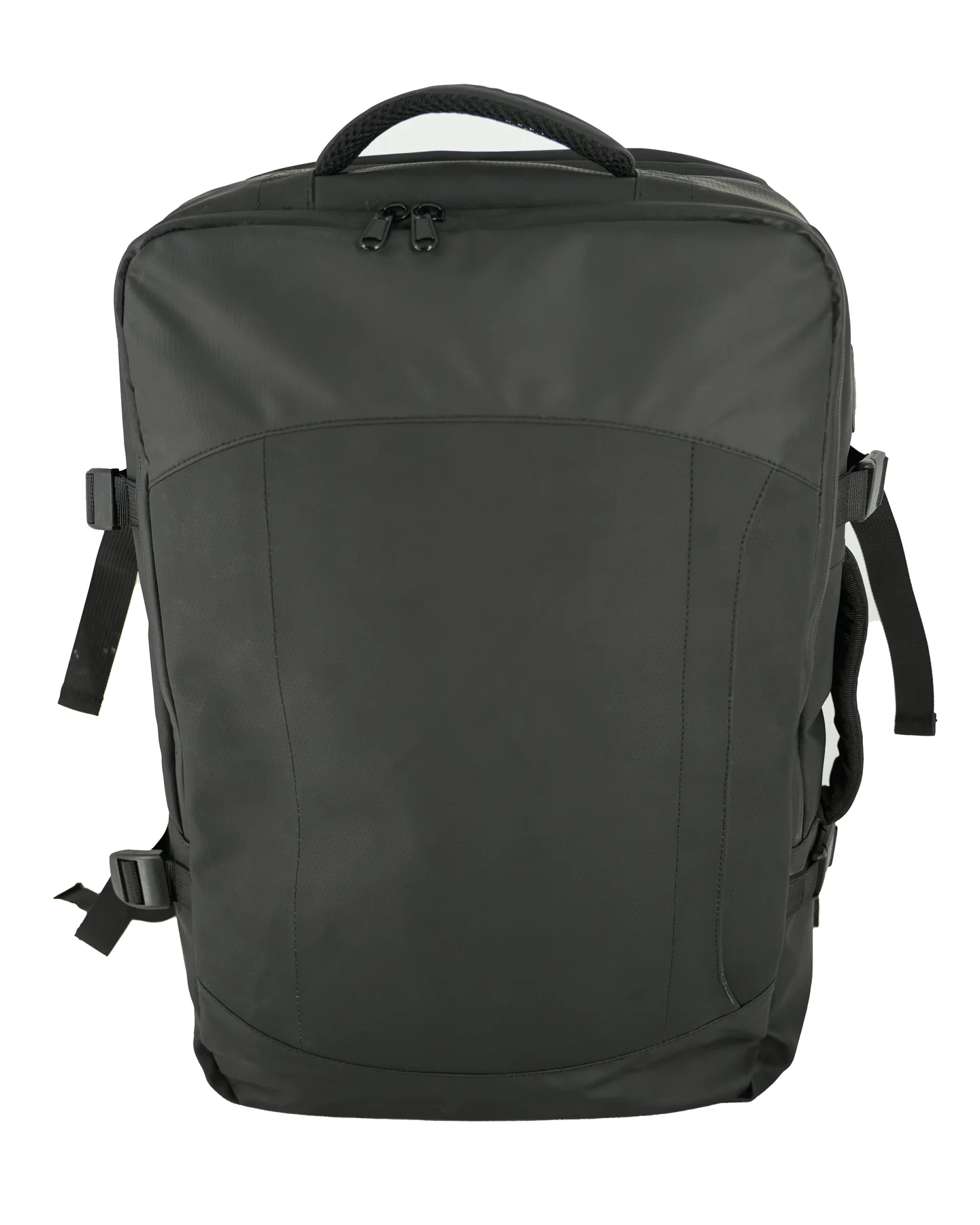
A laptop backpack's broad front panel can look crooked beside a straight zipper even when the cutting template is correct. Before asking the sewing team to pull the panel into alignment, check the incoming fabric. A distorted crosswise yarn line and a panel cut off its intended direction are different problems and need different decisions.
Review bow and skew while the fabric is still traceable to its roll and position. Then evaluate how that condition appears on the actual panel. This approach protects the distinction between material acceptance, cutting accuracy and finished-bag appearance; passing one review does not automatically pass the others.
01
Distinguish roll distortion from panel placement
In a woven shell, examine the crosswise yarn direction rather than relying only on the trimmed edge of a small swatch. A line that curves across the width presents a different condition from one that runs diagonally. A printed geometric line may also require examination separately from the underlying yarn direction.
ASTM D3882-08(2025) covers bow and skew in woven and knitted fabrics and can also address printed geometric designs. Its public scope identifies what the method measures; it does not supply a universal acceptance limit for business backpacks. When specifying formal testing, agree the edition, reporting basis and project limit with the supplier or laboratory using the complete method.
For development, label three references on the sample record: the fabric direction, the pattern's intended direction and the finished panel's visual centerline. If these are confused, a correction to cutting may hide a roll problem on one sample while making repeat production harder to control.
02
Inspect before a small swatch hides the context
Ask for material identification that includes supplier reference, finish, color and lot, plus the roll identity where available. Record where the inspected piece came from. A small presentation swatch can show texture and color but may not reveal how a line changes across the usable width.
Use a supplier-agreed inspection and conditioning procedure rather than stretching the fabric until it looks straight. Record the state in which observations were made. If the fabric was recently unrolled, laminated or otherwise handled, describe that context so a second reviewer can reproduce the comparison.
The ASTM public guidance notes that roll acceptance commonly considers the maximum bow or skew rather than only an average. For a buyer, the practical question is therefore not just whether one convenient area looks acceptable. Ask how variation within the roll was assessed and how material outside the agreed limit will be identified before cutting.
03
Choose the panel that exposes the problem
Select a visible component with a meaningful straight reference: the front face beside a zipper, a horizontal pocket opening or a rectangular laptop-compartment panel. Use the intended panel size and fabric orientation. An unusually small test piece can hide a distortion that becomes obvious across the final width.
Make a placement trial with the pattern outline and reference marks visible. Photograph the material flat, then evaluate a representative assembled component. For a subtle textured shell, agree the viewing distance and lighting. Avoid approving one sample under diffuse light and rejecting another under a harsh side light without recording the difference.
This is not the same decision as matching a decorative repeat. A motif can be positioned attractively while the underlying fabric direction remains wrong for the approved pattern. Conversely, a plain shell may have no motif to match but still need a controlled cutting orientation for consistent panel appearance.
04
Compare correction options without hiding their cost
If material falls outside the agreed requirement, separate supplier disposition from design experimentation. The options may include replacement, a documented supplier correction followed by reinspection, or a specifically approved use restriction. Do not silently change the pattern to consume unsuitable material.
Rotating a panel can change more than its appearance. Review what that rotation does to adjacent panels, stretch direction, surface sheen and cutting yield. A satisfactory isolated front panel is not sufficient if the corresponding pocket now appears inconsistent or the revised marker creates an unacceptable material cost.
Pulling or easing a panel during assembly should also be treated as a process change, not an invisible correction. If a proposed solution depends on special handling, reproduce it on the actual component and record who can perform it reliably. Do not approve a result that exists only while the fabric is held under temporary tension.
05
Write acceptance around observable references
Separate the three decisions
- Material: the agreed bow/skew method, limit, inspection basis and supplier disposition.
- Cutting: panel identity, orientation marks, placement rule and traceability to material.
- Assembly: the visual reference, inspection condition and acceptable finished appearance.
Keep measured results and appearance comments in separate fields. “Looks straight” is not a numerical test result, while a material result within specification does not guarantee that a pocket was positioned correctly. Both may be required for the product, but they answer different questions.
When comparing samples, include the same reference edge in each photograph and avoid perspective that makes a diagonal line appear straight. Retain the physical sample for disagreements that photographs cannot resolve. If formal measurements differ between supplier and buyer, agree a comparison procedure rather than selecting whichever result favors the current shipment.
06
Preserve roll identity after cutting
Once panels are bundled, retain enough identification to connect a questionable component with its material source. The useful level of traceability depends on the production plan, but mixing unlabelled panels before resolving a material issue makes investigation unnecessarily difficult.
Inspect the first representative assembly from a changed roll or revised material condition according to the agreed control plan. A previous approval of the fabric reference should not be treated as proof that every later delivery has the same geometry. Record whether the concern is repeated across pieces or isolated to a particular cutting or sewing operation.
If an assembled panel looks twisted, return to the evidence in order: material record, cut-panel direction, placement and sewing. This avoids blaming the roll for an assembly error or adjusting the sewing process to compensate for an unresolved incoming-material problem. Preserve rejected examples until the cause and disposition are documented.
07
Make the approval specific to the bag
For a business backpack, submit the visible panel layout, candidate shell and the reference edges that matter to the design. A plain front face beside a straight pocket opening may call for a different appearance review from a small curved side panel, even when both use the same fabric.
Include the material rule and panel-direction marks in the sampling tech pack. Ask for the retained placement sample, an assembled comparison and the proposed handling of nonconforming material. The result should be a reproducible decision, not a general promise that the fabric is “straight enough.”
These are development and purchasing checks, not claims of measured JKPD performance or certification. The project inquiry form can be used to share the intended construction and agree what evidence is needed before material and panel approval.
Discuss your bag development project
ANSON XIE
General Manager & Founder
Quanzhou Junkai Pengda Special Equipment Co., Ltd.
Email: ansonxie@jkpdtime.com
Phone: +86 177 5095 3355
WhatsApp: +86 177 5095 3355
Factory address: Floors 2–4, Building 1, Phase I, Huixin Intelligent Manufacturing Industrial Park, Hui'an County, Quanzhou, Fujian, China