
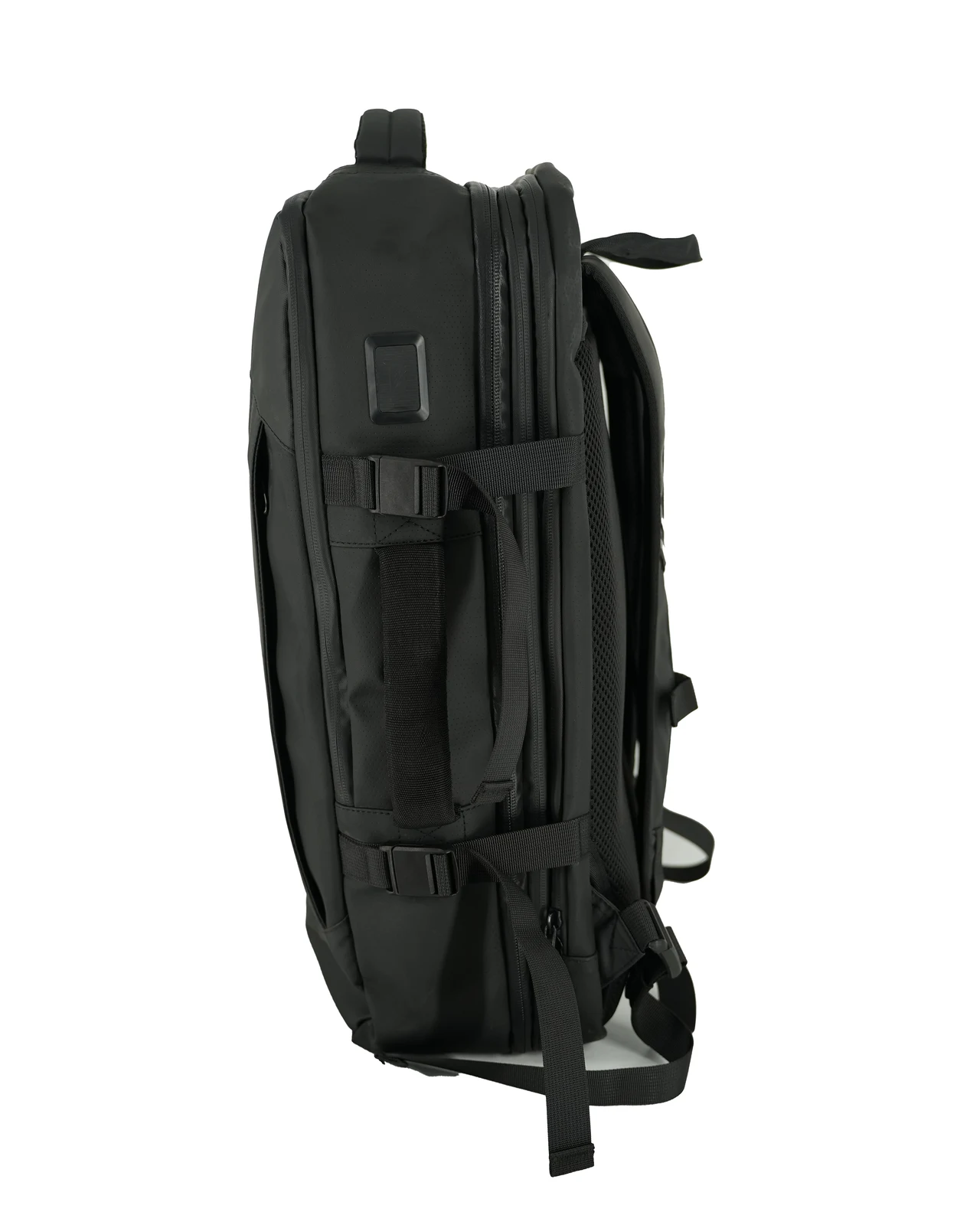
An external backpack cable port should be developed with its internal lead, storage arrangement and maintenance route. A visible port does not establish a power source, charging speed or device compatibility. Product information should describe the actual components and the intended sequence of use.
Development priorities: distinguish bag construction from electronic components; document the complete route; review access when packed; identify replaceable parts and maintenance steps on a sample.
01
Start with the component list
List the bag-mounted housing, internal cable and any supplied external lead separately. Identify which items are supplied by the brand and which the user provides. This prevents a photograph of a port from implying an included battery or a complete charging system.
02
Give the internal lead a defined route
Keep the proposed route clear of the main insertion space and make its connection end easy to find. Start by recording the exit, intended storage position and path in an empty compartment. Add the planned contents and observe whether they obscure, press against or move a connection.
Inspect the actual lead and connectors in the sample; the exterior view does not identify supported protocols, power, data transfer or certification.
Review opening the bag, retrieving an item, removing the power source, reconnecting and storing excess lead as separate actions. If each document retrieval requires moving a cable, consider the route and storage position before adding length. Extra length also needs somewhere to go.
03
Coordinate the exterior port with neighbouring parts
Review the port alongside the side handle, webbing and zipper. Check finger access for insertion and removal, and inspect how the connection projects when the bag rests on a surface or sits beside the wearer. Use the intended packed shape rather than an empty shell alone.
A rectangular housing is visible in this side view. Its internal construction and sealing are not shown. Do not infer water protection from the housing shape. If rain exposure is a requirement, define component and finished-bag expectations separately and obtain the corresponding evidence.
The exterior connection also needs a use location. State whether the bag is on a desk, carried or placed beside a seat during the intended activity. A connection convenient in one arrangement may be awkward in another, so reference photographs should identify the condition.
04
Define the maintenance route during sampling
If users are expected to replace a lead, they need access and clear instructions about which parts to handle. A service-only design needs its own repair procedure. Neither should depend on an assumption that a visible cable simply pulls free.
Record fixing points, accessible ends and any maintenance opening. After reassembly, inspect the item-storage space again. The supplied photographs do not show this procedure, so they cannot establish tool-free replacement for the sample.
Decide how a damaged component will be identified in after-sales communication. A component reference and a photograph of its location are more useful than a generic request for a backpack cable. Keep this information with the approved bag version.
05
Keep textile and electrical documentation distinct
Specify the shell, lining and port-area assembly by material reference and construction. Obtain separate documentation for electronic components. When fabric changes, recheck local wrinkling, lining tension and access around the port.
Power, protocol, compatibility and certification claims require evidence for the actual combination. Colour, USB wording or an isolated powered demonstration cannot replace that documentation. This article reports no charging or water-resistance test.
06
Hand over a complete configuration
Keep the approved sample identifiable
The approval pack should contain the bag version, component list, internal and external route photographs, intended equipment combinations and maintenance sequence. Distinguish user-provided equipment from included accessories, and revisit instructions after a component substitution.
These are company-library construction photographs. Explore related product-development discussions in the JKPD blog.
Related: business backpack laptop compartment design. See the photographed product reference.
Discuss your bag development project
ANSON XIE
General Manager & Founder
Quanzhou Junkai Pengda Special Equipment Co., Ltd.
Email: ansonxie@jkpdtime.com
Phone: +86 177 5095 3355
WhatsApp: +86 177 5095 3355
Factory address: Floors 2–4, Building 1, Phase I, Huixin Intelligent Manufacturing Industrial Park, Hui'an County, Quanzhou, Fujian, China