
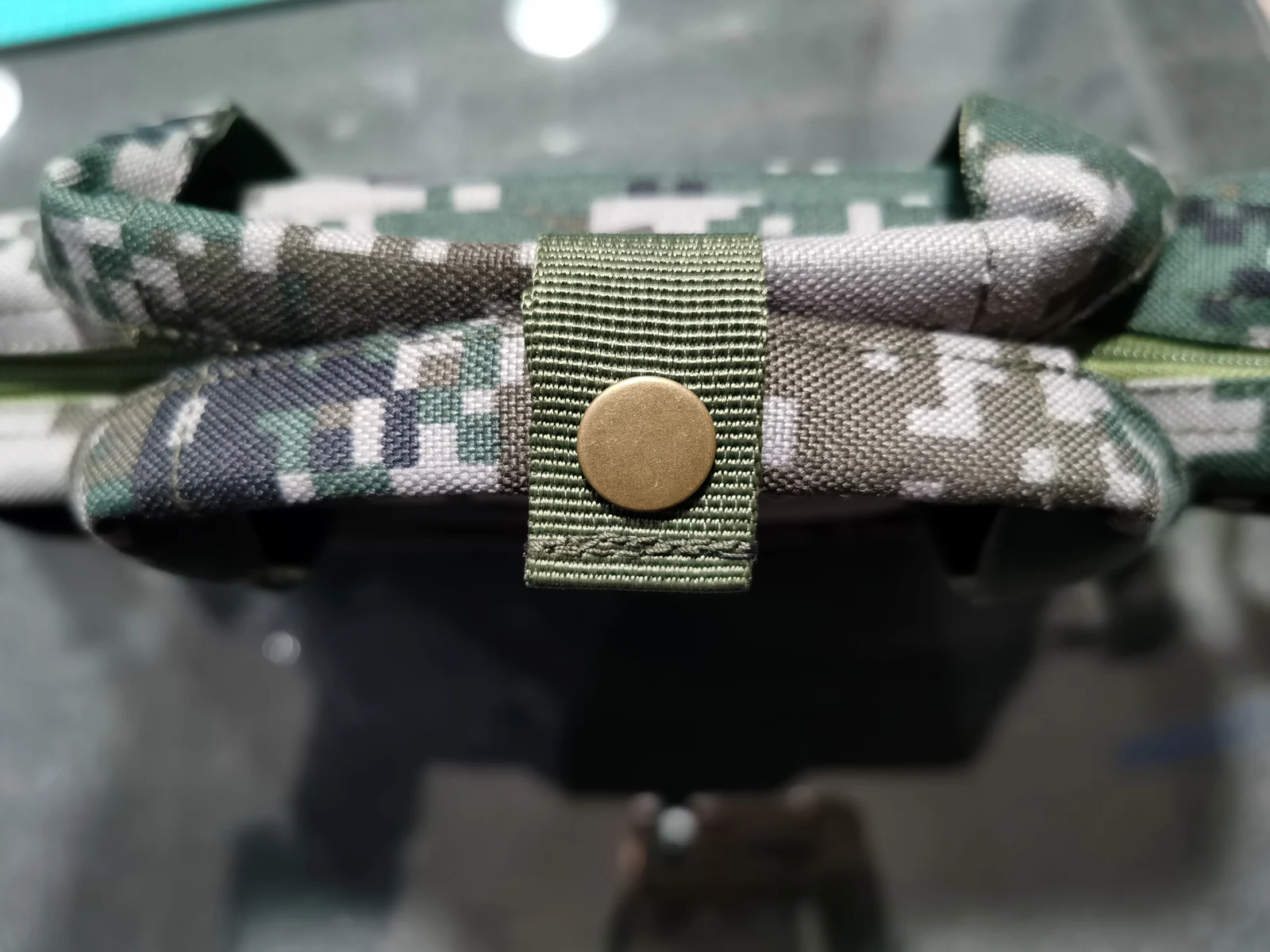
A paired-handle keeper should bring both grips into one usable hand position and release cleanly when the main compartment opens. Tightening the joining tab alone can make the closure harder to align. Leaving too much room can allow the grips to shift. Develop joining and releasing as one sequence.
This article concerns the connection between two handles. A joining tab is not the load-bearing attachment between a handle and the bag body. The photographs show a company-library sample, without establishing hidden reinforcement or carrying performance.
01
Locate the meeting point under a representative load
Begin with the shape of the packed bag. Contents can push the sides apart, while lifting draws the handles toward one another. A symmetrical arrangement on an empty, flat sample does not establish where the grips meet in use.
Use the intended documents and devices as development references. Bring the handles together naturally and mark the area held by the palm. The keeper should work around that meeting point without requiring one grip to twist under the other merely to close it.
02
Size the tab around the complete wrapping path
The detail photograph shows a short webbing tab across the two grips, with a round snap visible on its surface. It does not identify the snap model, its backing or its release force. None of those details should be inferred from appearance.
Include both finished grips, their covering layers and the installed closure when developing the tab allowance. A short tab may flatten the grips or pull the closure out of alignment. An overly loose one may permit movement between them. An adjustable trial position is useful before fixing the closure location in the specification.
03
Leave a deliberate place to start releasing it
Holding the bag and opening the keeper are different actions. If the free end disappears between the handles, the user may have to put the bag down and search for it. A long end may fold back into the palm during carrying.
Compare end direction and exposure on the sample, using both one-handed and two-handed release followed by reclosure. Record how each arrangement works rather than declaring a closure comfortable from its thickness. Pulling the handles apart is also a different action from taking hold of the tab end.
04
Move released components out of the opening
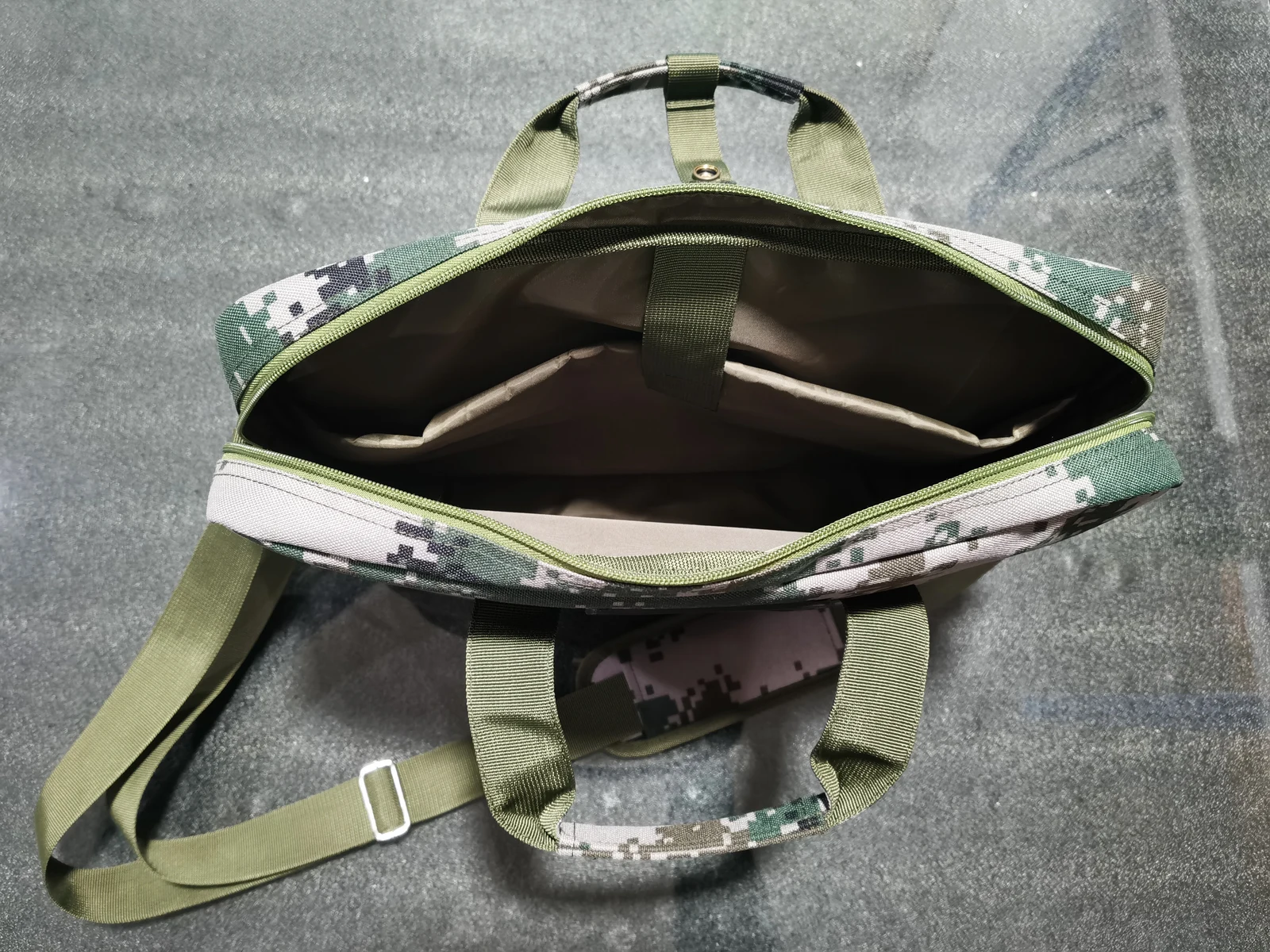
In the open-compartment photograph, the handles sit on opposite sides of the opening. This provides a useful reference for the released keeper: it should not bridge the document-removal path or fold into the route of the zipper slider.
If the keeper remains attached to one handle, identify that side and the direction of its free end. Remove a thick folder through the center and observe whether a handle repeatedly needs moving. A zipper reaching its open position does not by itself establish convenient access.
05
Match the closure to the access frequency
A work bag opened between meetings has a different handling pattern from a bag carried for a long stretch without access. The former may prioritize an unobstructed opening after release; the latter may prioritize a clear position for bringing the handles together again.
Review left- and right-handed use, grip rotation and the resting position of the free end when changing the keeper. Its role is to gather the handles. That does not demonstrate a higher bag load rating or an equal split of carrying forces.
06
Specify the sequence with three sample states
Record what the approved sample must show
Prepare photographs of the naturally aligned loaded handles, the closed keeper in the grip area and the main opening after release. Keep the sample revision and reference contents consistent. Identify the direction of the tab end and closure rather than leaving these details to an overall drawing.
Share the intended joining and opening sequence through the JKPD project contact page. Material selection, closure identity and validation conditions then belong in the project brief; these photographs do not replace them.
Topic reference only: L sir发现了’s discussion. No third-party text or images are reproduced.
More product development resources: JKPD Blog.
Discuss your bag development project
ANSON XIE
General Manager & Founder
Quanzhou Junkai Pengda Special Equipment Co., Ltd.
Email: ansonxie@jkpdtime.com
Phone: +86 177 5095 3355
WhatsApp: +86 177 5095 3355
Factory address: Floors 2–4, Building 1, Phase I, Huixin Intelligent Manufacturing Industrial Park, Hui'an County, Quanzhou, Fujian, China