
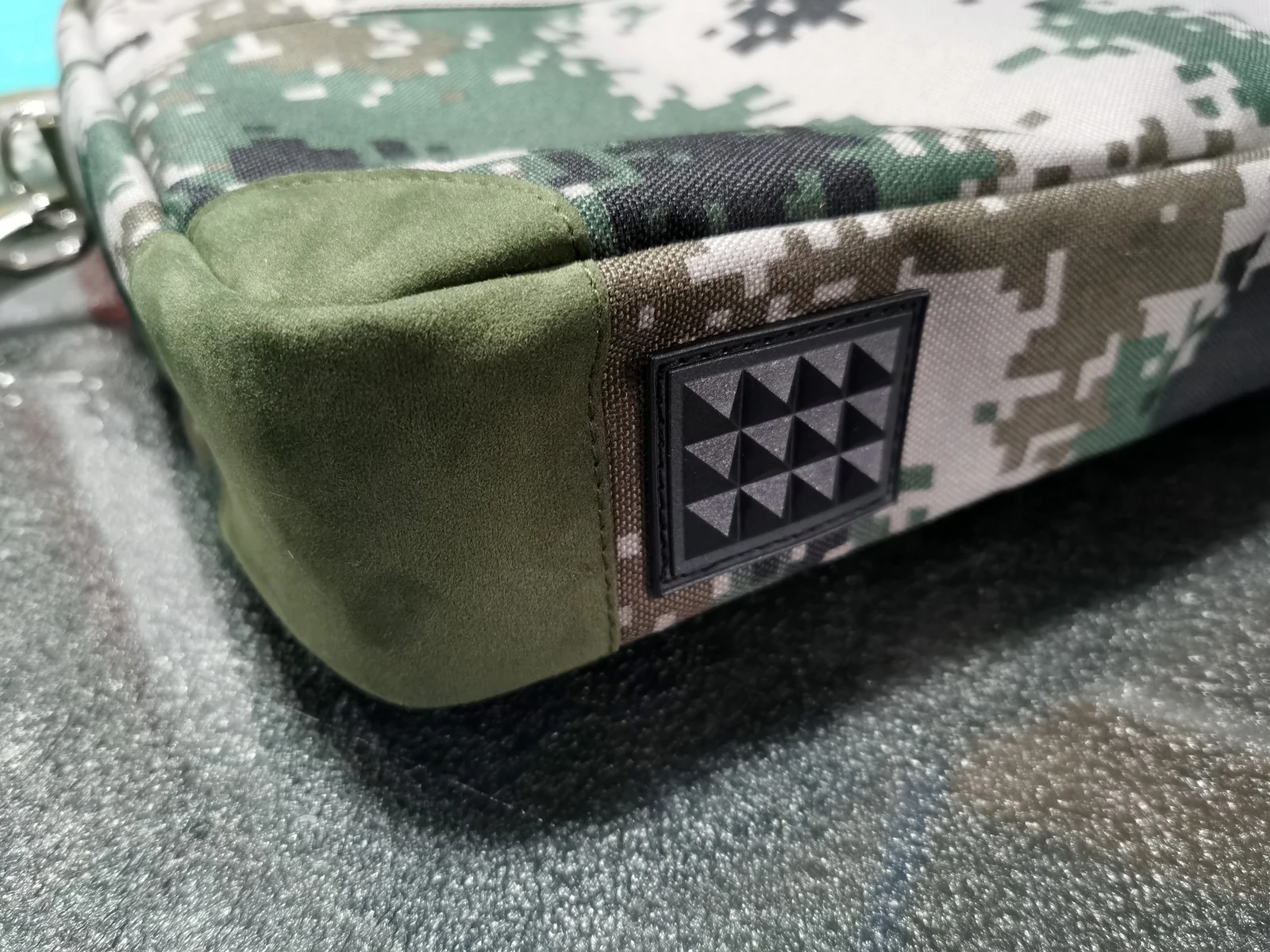
A corner overlay follows the turn of the bag body, while a raised pad changes the local profile of the base. These are separate construction decisions. The overlay needs defined coverage and joining boundaries; the pad needs defined position, height and attachment. A visible pad does not establish slip resistance, water protection or a self-standing bag.
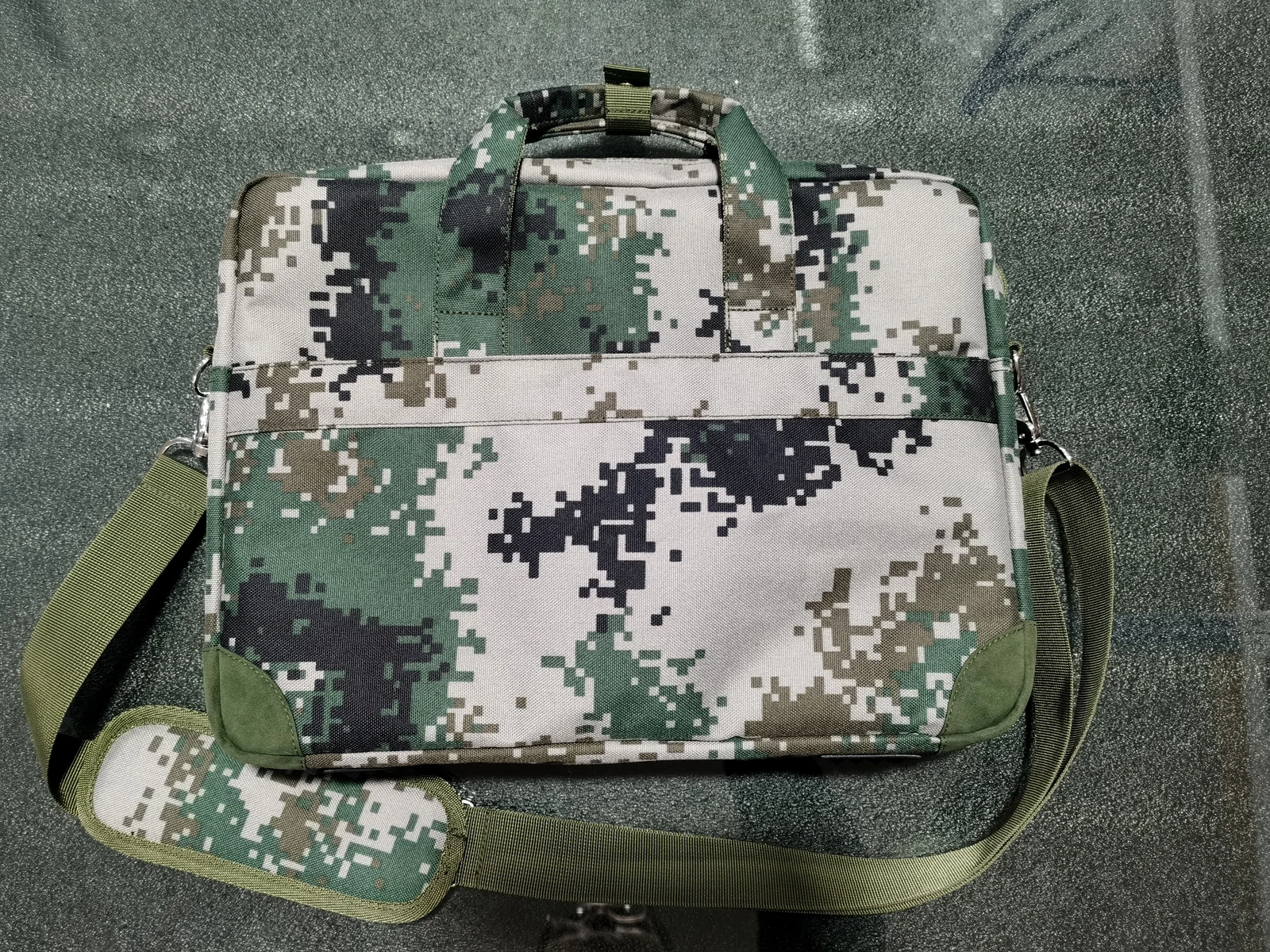
The photographs show green corner panels, a black textured raised piece and adjacent seams. Color and texture do not identify their materials, and these views are not abrasion, drop or load-test evidence.
01
Draw corner coverage and base contact separately
The overall photograph places green panels around the lower corners. Their contrasting shape provides a useful reference for marking that area. A development drawing should identify the faces they cover, their upper edges and the joins to adjacent panels.
The raised pieces need a separate base-position drawing. Even when a pad and overlay sit close together, one instruction such as “reinforced corner” cannot define both. Naming them separately allows coverage, contact layout and assembly to be discussed independently.
02
A visible pad does not reveal its attachment
The detail shows a square textured black piece raised above the surrounding surface. It does not show an internal backing, identify the attachment method or establish how many similar components exist across the complete base.
For a comparable project layout, request a full underside view and the internal connection details. Review the position relative to the corner seam and interior organization. Calling the piece a rubber, cushioning or anti-slip foot would add material or performance claims that this photograph does not establish.
03
Coordinate the overlay boundary with the pad footprint
A bag corner is part of an assembled three-dimensional join. The turning overlay, base seam and pad attachment can occupy a small area. Approving each component outline separately may leave crowded boundaries or difficulty achieving the intended assembled shape.
Mark the overlay edge, seam route and pad footprint on one local drawing. Let the proposed assembly determine the space required. Do not specify stitch length, hidden layers or fastening from this photograph. Any internal reinforcement should have its own defined extent in the construction information.
04
Keep contact layout separate from standing stability
A soft base changes shape with its contents. Pad positions only become useful in relation to the complete underside and the packed arrangement. A pad sitting proud of nearby fabric does not prove every seam stays clear of a desk or that the bag stands under every load.
If desk placement matters, define the normal placement posture and the location of files and devices before reviewing contact. Treat the distribution of contact points and independent standing as two development questions, rather than assuming one follows from the other.
05
Consider how coverage changes flexibility
A larger overlay can change the bend and visual proportion of the lower corner. A thicker local component also occupies more assembly space. Discuss these choices through packing, lifting and placing the bag, rather than treating larger coverage as an automatic durability improvement.
For a foldable bag, define the intended fold location and condition. For a briefcase carrying rigid files, record where the internal edges sit relative to the external corners. Those tasks need not lead to the same coverage shape.
06
Give purchasing distinct component identities
Record what the approved sample must show
List the overlay, raised pad and required attachment or backing components separately. Retain supplier references, assembly drawings and sample revisions together. If abrasion, grip or cleaning performance is required, agree on its evidence and conditions separately instead of inferring it from the sample image.
Share the intended placement posture and corner outline through the JKPD project contact page. Establish what each component does and where it joins before finalizing its material and validation requirements.
More product development resources: JKPD Blog.
Discuss your bag development project
ANSON XIE
General Manager & Founder
Quanzhou Junkai Pengda Special Equipment Co., Ltd.
Email: ansonxie@jkpdtime.com
Phone: +86 177 5095 3355
WhatsApp: +86 177 5095 3355
Factory address: Floors 2–4, Building 1, Phase I, Huixin Intelligent Manufacturing Industrial Park, Hui'an County, Quanzhou, Fujian, China