
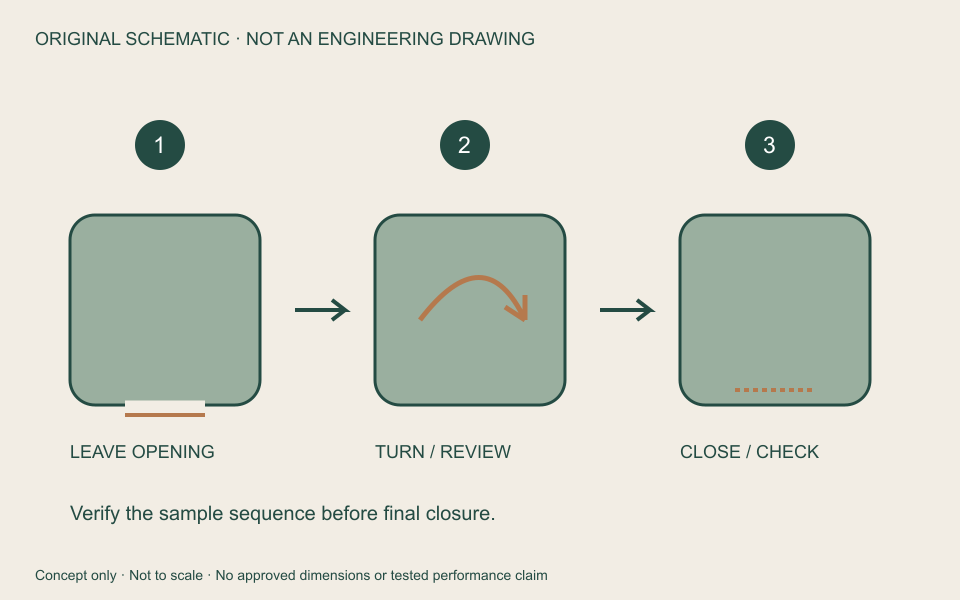
For a soft bag assembled through a turning opening, review opening location, the turning sequence and final closure during sampling.
01
Identify the assembly opening
Distinguish user access from the temporary turning opening on the drawing. Mark location, end boundaries, associated layers and final closure method. A requirement for no visible stitching does not define the construction.
Record alternatives where applicable. This article addresses projects with a turning opening, not a method that every soft bag must use.
02
Review the complete component combination
Include the zippers, pockets, webbing and other components specified at that assembly stage. Follow the intended sequence and state what is installed before turning and what follows afterwards.
Photograph access and handling, recording grasping locations and rearrangement steps. A simplified fabric shell without attachments does not confirm access for the finished combination.
03
Inspect before final closure
After turning, review ends, corners and relative layer positions before closing the opening. Record any adjustment still needed. Photograph visible folds, exposed edges or misalignment without assigning a cause from appearance alone.
The original diagram groups opening, turning and closure in one review sequence. It is not an approved sewing method, product photograph or process test.
04
Check both faces after closure
Close the opening using the agreed method, then inspect the visible face, inside and both ends. Where the user reaches that area, review the agreed retrieval action for exposed thread ends or interference.
Define verification separately where closure strength or repeated use matters. A concealed closure does not turn appearance approval into performance approval.
05
Link process evidence to approval
Retain photographs of the temporary opening, post-turning state and final closure under one sample ID. Record material combination, attachment revisions, assembly steps and unresolved matters.
Recheck turning and closure after changes to pockets, webbing or opening location. This lets purchasing teams verify completed steps and gives later samples a defined construction reference.
Share material references and sample requirements through the JKPD inquiry page.
Discuss your bag development project
ANSON XIE
General Manager & Founder
Quanzhou Junkai Pengda Special Equipment Co., Ltd.
Email: ansonxie@jkpdtime.com
Phone: +86 177 5095 3355
WhatsApp: +86 177 5095 3355
Factory address: Floors 2–4, Building 1, Phase I, Huixin Intelligent Manufacturing Industrial Park, Hui'an County, Quanzhou, Fujian, China