
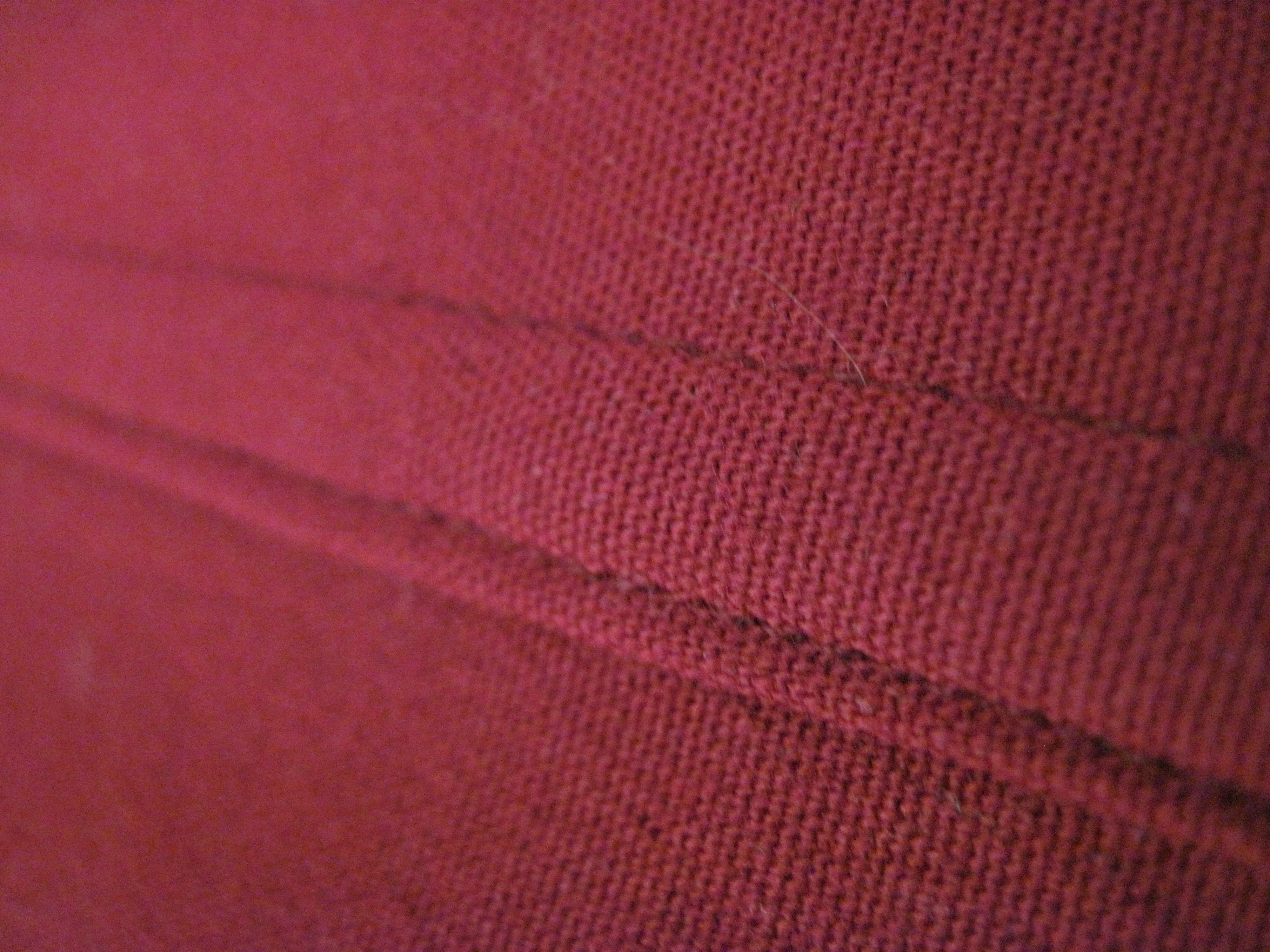
Photo: kellyhogaboom. CC BY-SA 2.0 · Original source. Unmodified for this article. The photograph remains under its stated license; no endorsement, specific material grade or JKPD use is implied.

01
Parallel lines do not identify the structure
The important features of a flat-felled seam are enclosed cut edges and a secured fold. Two parallel lines on a panel do not establish the hidden construction. Request both faces and a local construction sample.
For a soft-bag panel, identify whether the proposal is a joining method or simply decorative stitching. Suitability requires the selected material combination and connection validation. A clothing tutorial’s durability description cannot be transferred directly into a performance claim for a different bag assembly.
02
Fold direction locates the material build-up
WeAllSew’s example shows a wider allowance enclosing a narrower allowance before the folded area is secured. Different production routes can give similar visible results. Specify the actual layer arrangement and fold direction rather than relying on the English seam name.
The photograph shows the surface and visible stitching of a seam identified by its source as flat-felled. It does not expose every hidden cut edge or establish stitch length, fibre content or connection strength. Use it to discuss visible form, then verify the proposed construction physically.
03
Locate the finished seam on the pattern
Define joining position, fold direction and finished width before distributing the allowances. Separate finished folded width from cutting allowance so trimming and folding do not move the intended panel boundary.
Near a pocket, print or hardware tab, check whether the fold occupies space required by a later operation. Resolve those relationships before approving visible line spacing. A visually neat coupon still needs to fit the assembly sequence. Mark the approved direction on the pattern so mirrored panels do not receive unintended opposite treatments.
04
Sample thickness transitions
Build an intersection coupon where the folded seam crosses a base edge, handle tab or reinforcement boundary. Use the actual layers. Check feeding, capture of the folded edge and access for later sewing.
A photograph of a pressed-flat sample does not establish stable assembly. Do not remove unapproved layers merely to improve its appearance. Record thinning, trimming and direction changes, then review their effect on both connection and appearance. Keep the intersection sample with the straight reference so the production handover includes the difficult section as well as the easiest one.
05
Make reverse-side inspection specific
On the face, inspect stitch continuity and panel shape. On the reverse, inspect fold capture, edge coverage and endpoints. For a missed fold, separate needle position, fold width, feeding and local layer issues instead of assigning a vague workmanship label.
A confirmed straight construction may still need a new sample for another direction or curve. Do not extend a straight-seam approval around an entire shaped bag without reviewing the geometry. Record what the inspection can actually see and use a construction sample for hidden areas.
06
Do not infer strength from the stitch layout
Keep the sample and its record together
Define a connection sample and review conditions for the intended product. Record thread failure, fabric damage, seam slippage and appearance changes separately. Line count, heavy-looking thread and folded width cannot be converted directly into a strength value.
Keep material identity and evaluation conditions traceable between candidates. A useful comparison needs to explain what changed. This article supplies no comparative test data and makes no claim that JKPD has used the seam in a particular project.
07
Release a construction reference
Retain straight, intersection and endpoint samples with finished width, fold direction, fabric, needle and thread, and pattern revision. Include appearance and manufacturing requirements in the RFQ, with a review rule for material changes.
This lets buyers compare a complete proposed process rather than the appearance of two lines. The approved reference should show what remains hidden in normal photographs and identify where the process ends or changes. It then becomes useful for troubleshooting and future revisions as well as initial sourcing.
Share your application, candidate components and sample requirements through the JKPD project inquiry page.
Discuss your bag development project
ANSON XIE
General Manager & Founder
Quanzhou Junkai Pengda Special Equipment Co., Ltd.
Email: ansonxie@jkpdtime.com
Phone: +86 177 5095 3355
WhatsApp: +86 177 5095 3355
Factory address: Floors 2–4, Building 1, Phase I, Huixin Intelligent Manufacturing Industrial Park, Hui'an County, Quanzhou, Fujian, China