
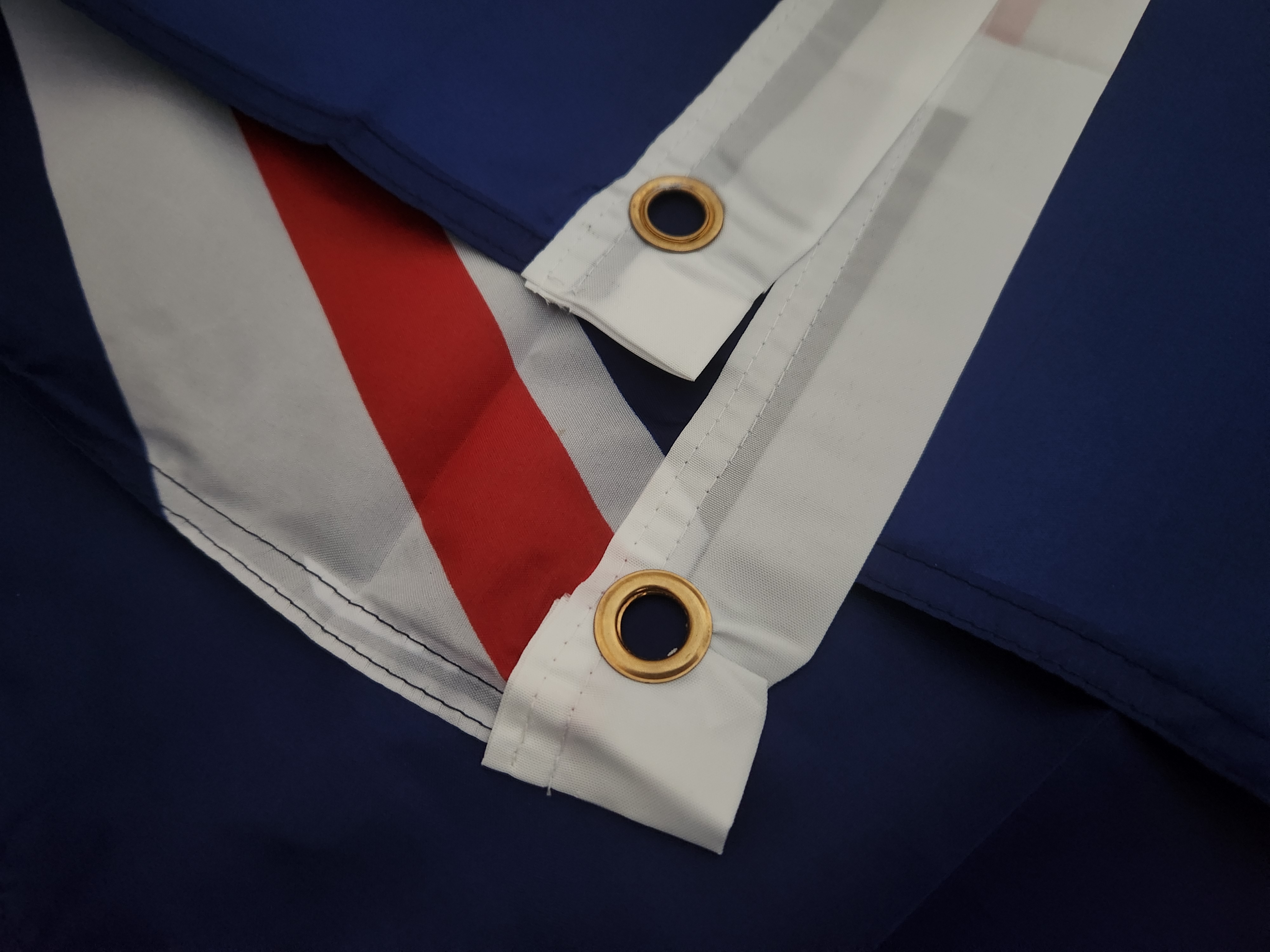
Photo: Panamitsu. CC BY-SA 4.0 · Original source. Unmodified for this article. The photograph remains under its stated license; no endorsement, specific material grade or JKPD use is implied.

01
Define the job before choosing a diameter
A drawcord outlet, a ventilation opening and a decorative hole have different jobs. Start by recording whether cord slides repeatedly, whether users can touch the reverse side, and where seams or folded edges sit. Calling every part a matching-colour eyelet hides these differences.
This guide concerns ordinary soft-bag development. Covering a cut edge does not establish pull-out strength, corrosion resistance or waterproofness. A ventilation opening is not automatically suitable as a loaded attachment. Where a connection carries load, the development team needs a separate load direction, failure definition and validation plan.
02
Separate hardware dimensions from the fabric hole
Stimpson’s grommet-and-washer listing separates hole size, flange diameter, length under the flange and metal thickness, alongside washer dimensions. A supplier size number alone is therefore an incomplete purchasing description. Request the drawing and matched component list for the actual article.
Keep finished clear opening, recommended punched hole, flange diameter, barrel length and washer article in separate fields. The opening seen by a moving cord and the hole prepared before setting are different interfaces. Do not assume identical dimensions. The photograph shows installed eyelets and adjacent stitching on a flag, illustrating the hardware-to-textile interface; it is not a bag production case.
03
Measure the stack at the installation location
Build the actual sequence of shell, lining, reinforcement and folded layers before agreeing barrel length and tooling with the hardware supplier. A single fabric thickness is not the installed stack. Flat panels and folded intersections within one bag may need different arrangements.
Make a coupon that preserves the intended layers and label its fabric article, reinforcement area, hole preparation and orientation. A successful flat coupon still needs confirmation at the assembled location, where tool access may differ. Avoid treating extra setting pressure as a universal cure for looseness, or adding washers to conceal an unsuitable barrel length.
04
Give the washer and reinforcement separate roles
A washer belongs to the hardware assembly; reinforcement changes the surrounding soft construction. Identify whether the chosen part uses its own rolled edge, a matched washer or another arrangement, then obtain the supplier’s installation requirements. Similar finish colour does not make washer styles interchangeable.
Review reinforcement area, attachment and edge transition with the pattern. Does the patch interfere with a nearby seam, prevent the mouth folding or create a hard local step? Keep both faces and the layer sequence of each coupon. Those records help distinguish hardware deformation, an oversized cut hole and damage in the surrounding textile.
05
Inspect the moving-cord contact surface
Inspect the inner rim, rolled edge, joint and reverse face for unexpected burrs or cracks. Check passage with the intended cord. A nominally suitable opening can still interact badly with an uneven edge or a skewed installation, and a clean front face cannot replace reverse-side inspection.
Define operating, appearance and looseness checks for dry use and any expected wet use, including repeated cord movement. The project must set the repetitions and acceptance criteria. Where corrosion performance matters, ask for the applicable method and report scope. A plating description alone is not evidence. These are proposed validation tasks, not claimed JKPD test results.
06
Release samples with paired records
Keep the sample and its record together
Link each sample identifier to hardware batch, washer, fabric stack, tool and setting record. If the fabric edge is damaged, compare hole-to-barrel fit, formed hardware and surrounding layers. If the cord wears, examine contact edges and pulling direction. Change traceable variables rather than replacing fabric, hardware and tooling together without a comparison.
Review the assembled bag both empty and with its intended contents, because panel shape can change around the opening. Photographs record appearance; strength decisions require the corresponding method. Keep the unsuccessful coupon as well as the preferred sample so the next production review can see what changed.
07
Finish the RFQ with an assembly description
Send the application and location, grommet and washer drawing references, actual stack and material list, hole preparation and tooling requirements, finish, sample records and agreed inspection criteria. Outside diameter, colour and order quantity are only part of this description.
Ask whether the proposed barrel and washer combination fits the complete supplied stack, what hole preparation and tool it requires, and what must be revalidated after a thickness change. Seek an answer tied to the selected assembly and sample. A general statement that a part is suitable for bags leaves the most consequential interfaces unresolved.
Share your application, candidate components and sample requirements through the JKPD project inquiry page.
Discuss your bag development project
ANSON XIE
General Manager & Founder
Quanzhou Junkai Pengda Special Equipment Co., Ltd.
Email: ansonxie@jkpdtime.com
Phone: +86 177 5095 3355
WhatsApp: +86 177 5095 3355
Factory address: Floors 2–4, Building 1, Phase I, Huixin Intelligent Manufacturing Industrial Park, Hui'an County, Quanzhou, Fujian, China