
Approve bag bartacks against placement, the actual material stack and agreed verification requirements, rather than stitch shape alone.
01
Identify what the stitches must join
Mark webbing, body panels and any specified internal reinforcement separately. Identify the layers that stitches must pass through before choosing a pattern. Distinguish decorative stitching from a connection requirement.
Record stitch location relative to the webbing end and panel edge. Give the coupon a reference ID and capture both faces. An exterior photograph alone cannot establish whether an internal layer was captured.
02
Use the intended material combination
Use the intended webbing, fabric, internal layers and thread combination. Record material IDs and layer order, retaining the physical coupon against the drawing revision. A single fabric layer is not a substitute for the intended reinforced connection.
JUKI’s LK-1900C documentation describes tension settings in relation to thread, material and sewing conditions. This equipment example supports recording conditions; it does not establish JKPD equipment ownership or connection strength.
03
Review both faces separately
Review position, edge relationships and visible stitching on the face; examine visible tangling, missing stitching or uncovered areas on the reverse. Record the observation and location without assigning a cause to a thread or machine without investigation.
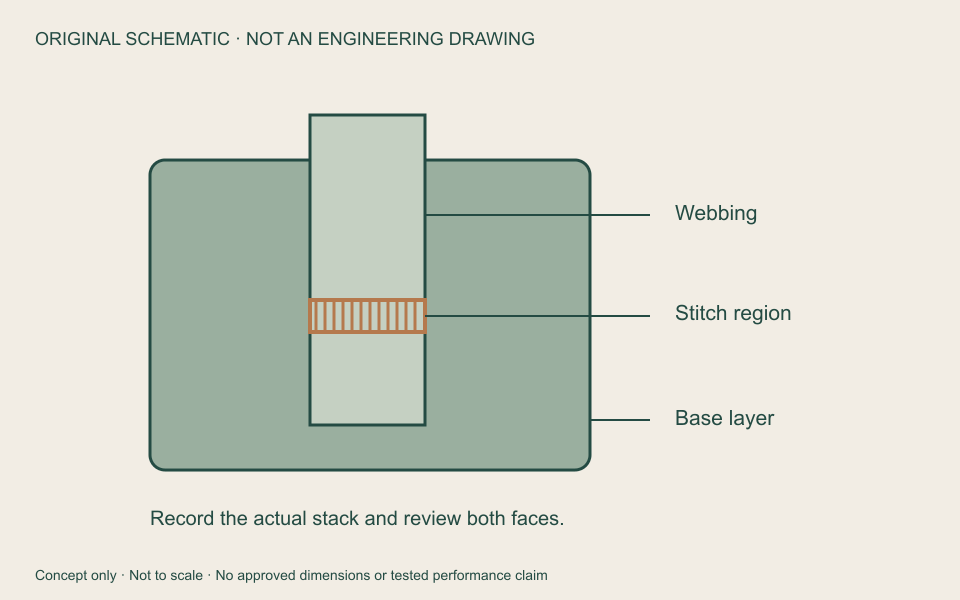
The original schematic shows webbing, a base layer and a stitch region only. It specifies no thread size, stitch count, pattern dimensions or load rating.
04
Separate appearance from verification
Where connection retention matters, agree the object, direction, conditions and acceptance criteria separately and link them to the sample ID. Appearance approval does not establish performance. Do not treat denser stitching as proof of durability.
After changing the pattern or materials, identify affected verification. A hypothetical status such as “placement approved, connection verification pending” is a record example, not a test result.
05
Retain the approved combination
Retain the local drawing, material stack, coupon, face and reverse photographs, and verification status. Define the location and revision covered by approval. Do not extend one pattern approval to different widths, thicknesses or connected components.
Buyer feedback should identify the layer, edge or step that needs revision. This gives subsequent coupons and finished samples the same review basis.
Share material references and sample requirements through the JKPD inquiry page.
Discuss your bag development project
ANSON XIE
General Manager & Founder
Quanzhou Junkai Pengda Special Equipment Co., Ltd.
Email: ansonxie@jkpdtime.com
Phone: +86 177 5095 3355
WhatsApp: +86 177 5095 3355
Factory address: Floors 2–4, Building 1, Phase I, Huixin Intelligent Manufacturing Industrial Park, Hui'an County, Quanzhou, Fujian, China