
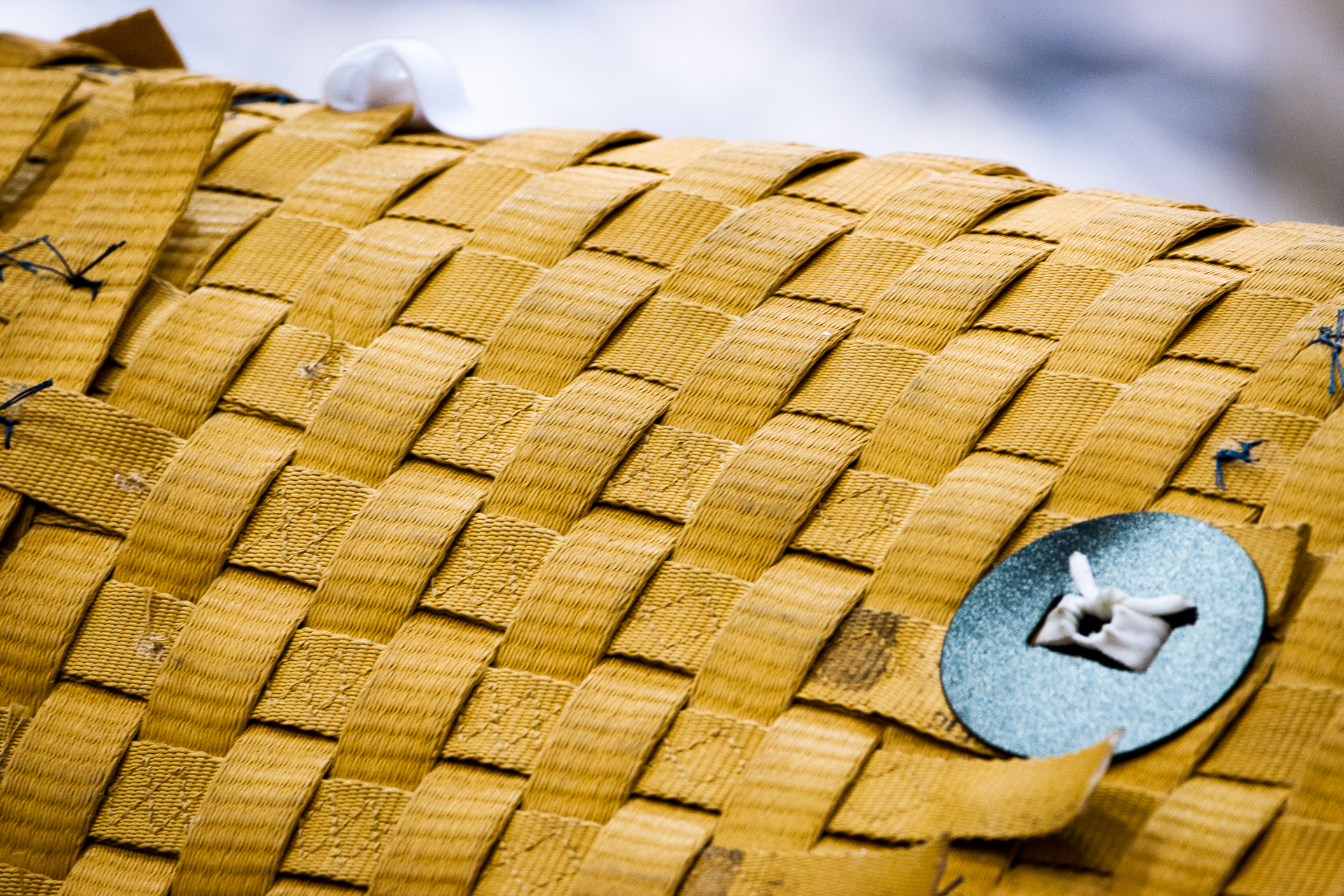
Photo: Paul Hudson. CC BY 2.0 · Original source. Unmodified for this article. The photograph remains under its stated license; no endorsement, specific material grade or JKPD use is implied.

01
Identify the aramid type before using a brand name
Aramid is a category of aromatic polyamide fibres. Teijin Aramid distinguishes meta- and para-aramid by their bond arrangement. Descriptions such as heat resistant or high strength do not make these categories interchangeable. Identify the fibre category, producer and article, treating names such as Kevlar and Twaron as their respective brands.
For a bag reinforcement or protective component, define the required behaviour first. Fibre-level advertising without textile and connection details cannot become a finished-bag guarantee. Mentioning a brand here does not imply that JKPD has purchased or used it.
02
Keep fibre form, yarn and textile as separate levels
The producer lists filament, staple and pulp forms. Twaron product literature identifies that product as para-aramid. A statement about pulp in another composite does not validate the sewing behaviour of a filament fabric. Continue the bag-material specification through yarn linear density, textile construction, mass, thickness and blend content.
The real photograph above, identified by its source as Kevlar, shows interlaced broad strips and local stitching. It illustrates why construction matters beyond the fibre name. It is not a magnified view of ordinary bag face fabric or technical validation of a particular textile article.
03
Write requirements for the actual component
Yarn, strip, full-width textile and sewn-component tests concern different specimens. Check specimen type, direction, dimensions, gripping and conditioning before comparing load and elongation. A result in one direction does not cover another direction or automatically explain edge tearing and seam failure.
For a local reinforcement inquiry, include the base fabric, reinforcement orientation, seam position and loading direction. Ask for material data separately from coupons of the proposed assembly, then agree the component assessment. This is a suggested development sequence, not testing performed for this article. It supplies no recommended carrying load or protection rating for a finished product.
04
Specify exposure together with any covering layer
Teijin’s material overview identifies sensitivity to UV light. For exposed reinforcement, outdoor strips or prolonged sunlight, define the actual exposure before requesting data for the relevant article. Yellow appearance does not establish weathering behaviour or identify the finish used on every aramid grade.
Give covering fabric, coating and laminate layers their own article or revision. Consider comparing material and connection coupons before and after agreed conditioning, recording surface change and relevant functional measures. If only fibre data are supplied, identify the remaining evidence needed after weaving, coating and assembly. The presence of a covering layer is not itself a verified UV-resistance guarantee.
05
Retain coupons for the cutting and sewing combination
Do not transfer another synthetic fibre’s hot-sealing practice directly to aramid. The producer describes decomposition rather than melting; the actual cutting approach still needs confirmation from the textile and equipment suppliers. Compare suitable cutting tools and edge-treatment coupons, recording loose filaments, edge appearance and subsequent connection behaviour.
Record the complete sewing assembly
Sewing coupons should contain the actual layers, facing and backing, with needle, thread, spacing, allowance and direction recorded. Separate damage around needle holes, slippage and failure location. A neat appearance does not establish connection acceptance. A hand-cutting demonstration also cannot justify finished-product claims about cut resistance, flame resistance or other protective functions.
06
Trace raw-material claims separately from performance
For recycled or bio-based claims, request declarations, scope and traceability records covering the supplied version. Feedstock route, accounting method and actual textile performance are different questions. A producer’s pilot announcement does not make all commercially available aramid the same recycled or bio-based content.
The candidate video below appears under Teijin Aramid in public search metadata and concerns a feedstock pilot. The video is not used as technical evidence here. It is supplementary research only, without claims about commercial supply, content, emissions or performance. It is neither the photographed construction nor a JKPD project record. Verify the relevant supplier declaration before developing any related product wording.
Supplementary viewing (content unreviewed): Teijin Aramid | Proves ability to produce high-performance fibers from green raw materials · Teijin Aramid
Supplementary viewing only; content has not been independently reviewed for this article. No processing, performance or environmental conclusions are drawn from the video. Use the original external link; availability may vary.
A demonstration is not performance certification; internet access is required.
07
Build a purchasing specification that can be compared
List fibre category and grade, blend content, yarn and textile construction, mass and thickness conditions, finish and covering, colour, panel orientation and connection method. Reports should identify sample state, batch, test object and method. Do not let a fibre datasheet stand in for a finished-bag assessment.
Link the approved coupon, material record and applicable acceptance conditions. Revisit affected requirements when the grade, weave, coating, backing or seam changes. The purchasing decision concerns how a defined material construction fits its task. A high-performance fibre name alone is not a finished-product function, certification or reason to omit the ordinary development records.
Useful sample-review questions are: which layer was tested, which results remain applicable after the cover changes, and which base-fabric batch was used in the connection coupon? Record the answers so later teams can distinguish a fibre substitution from a textile substitution or assembly change. Leave unanswered items open rather than filling them with assumptions about appearance or brand reputation.
Related reading: Dyneema webbing specifications.
Share the intended use, candidate article and available records through the JKPD project inquiry page.
Discuss your bag development project
ANSON XIE
General Manager & Founder
Quanzhou Junkai Pengda Special Equipment Co., Ltd.
Email: ansonxie@jkpdtime.com
Phone: +86 177 5095 3355
WhatsApp: +86 177 5095 3355
Factory address: Floors 2–4, Building 1, Phase I, Huixin Intelligent Manufacturing Industrial Park, Hui'an County, Quanzhou, Fujian, China