
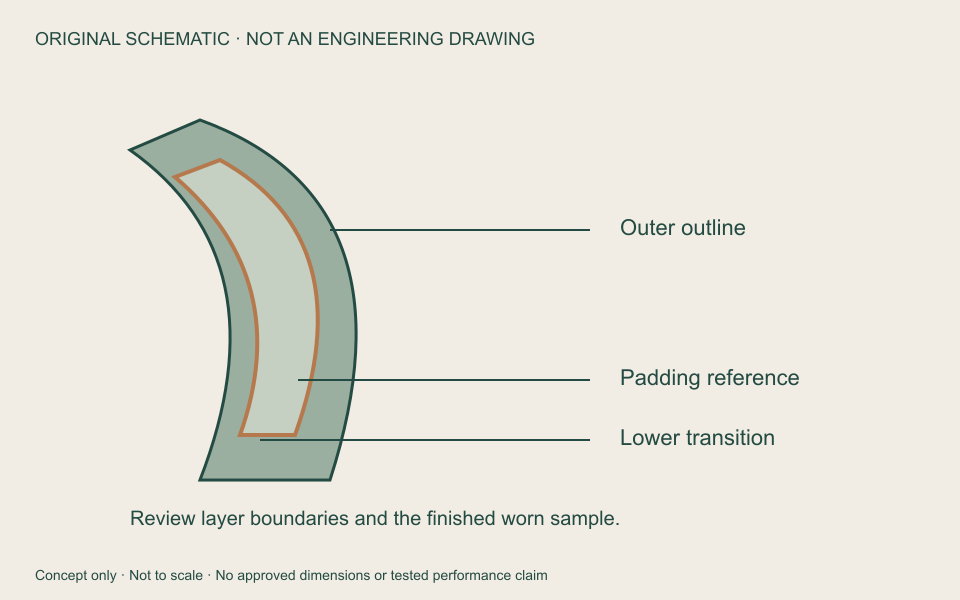
Review strap padding against the finished outline, stitch regions and adjustment components rather than material names or thickness alone.
01
Draw separate outlines
Show outer face, contact face and padding reference outlines separately. Identify where padding begins and ends, including upper attachment, lower webbing transition and adjusters. This defines the review area.
Do not substitute the full strap outline for the padding pattern. Layer dimensions depend on the project construction; the schematic supplies no universal cutting dimensions.
02
Retain the material combination
Make a local sample from intended face materials, padding and contact layers. Record material IDs, orientation and revision. A material name is not a substitute for an identified physical reference.
When comparing options, keep other conditions traceable and state which layers change together. Do not infer recovery, airflow or compression performance from a material name without supporting information.
03
Inspect edges and webbing transitions
Review padding boundaries against intended stitching and edge construction. Photograph visible projection, exposure or left-right differences. Do not infer hidden layer positions from exterior photographs.
Exterior photographs alone do not reveal internal padding. The original diagram explains general layer relationships, not a verified section of any particular product.
04
Review after wearing and adjustment
Review the finished sample with agreed user references, clothing layers, contents and harness adjustment. Record contact positions and handling observations for both straps, including interaction with adjusters.
Thickness or softness alone does not establish comfort approval. Where assessment is static, retain that scope rather than extending it to movement or prolonged carrying.
05
Record approval scope
Retain drawings, material combination, local sample, finished photographs and worn conditions. Distinguish placement and appearance approval from use observations and open issues.
Recheck affected combinations after changes to padding outline, contact face, stitch region or adjusters. Mark the boundary needing revision instead of an undefined request for a softer strap.
Share material references and sample requirements through the JKPD inquiry page.
Discuss your bag development project
ANSON XIE
General Manager & Founder
Quanzhou Junkai Pengda Special Equipment Co., Ltd.
Email: ansonxie@jkpdtime.com
Phone: +86 177 5095 3355
WhatsApp: +86 177 5095 3355
Factory address: Floors 2–4, Building 1, Phase I, Huixin Intelligent Manufacturing Industrial Park, Hui'an County, Quanzhou, Fujian, China