
Develop a phone slip pocket around the cased device and the place where a hand can grasp it. Being able to insert the phone does not establish easy retrieval. Leaving more of it exposed also does not resolve retention by itself. Coordinate the pocket mouth, base and outer-compartment closure around a defined retrieval action.
Use the actual phone-and-case combination as the reference. Record insertion, grasping and outer-compartment closure separately. Bare-device dimensions, flat pocket width and overall bag dimensions describe different things.
01
Start with the complete everyday device
Include the protective case, camera projection and any ring or other attachment that normally stays on the phone. If the intended routine requires an attachment to be removed first, state that action. Removing it temporarily during sampling can conceal a restriction that returns in everyday use.
Consider width, height and thickness together. A thick case can consume entrance clearance, while a projecting back attachment can change the practical insertion direction. Define the reference assembly before asking procurement which additional combinations must be covered. A model name alone does not establish universal compatibility.
02
Define a grasping area above the mouth
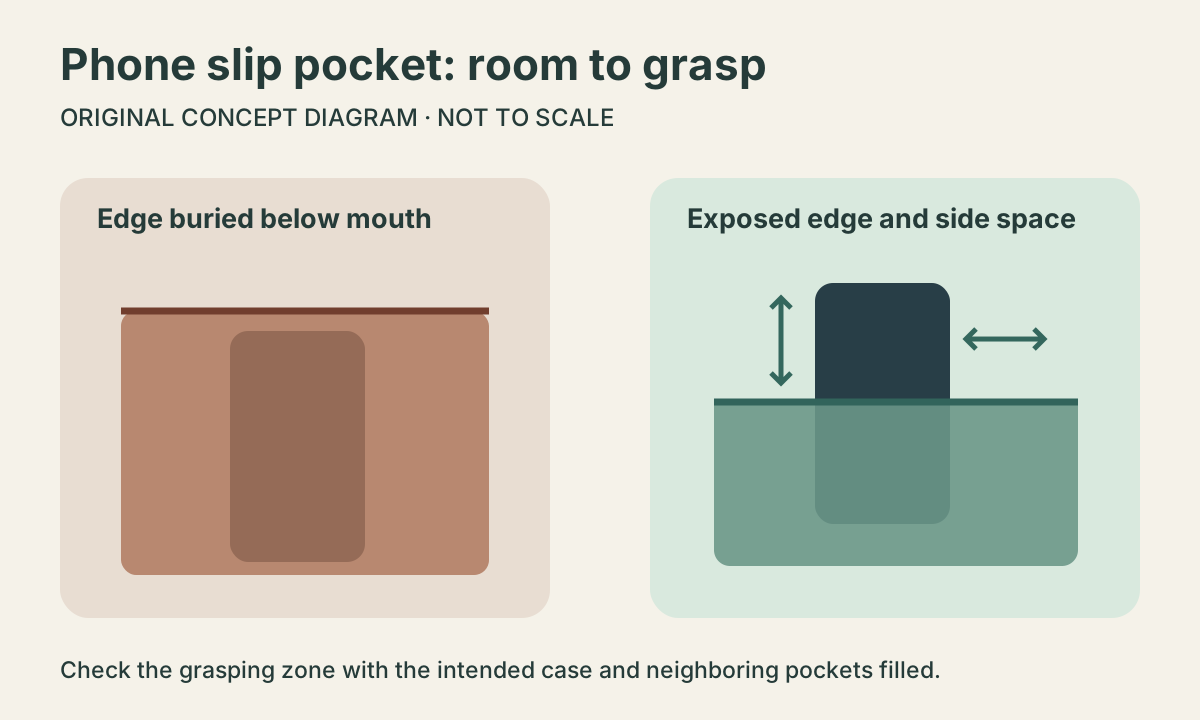
The pocket mouth needs to leave an accessible place to hold the phone. If only a fingertip grip on its edge is possible, compare a shallower pocket, a revised mouth shape or another insertion direction. A visible top edge does not establish that the fingers have enough room to work.
The diagram contrasts a buried edge with a pocket mouth that leaves room above and beside the reference phone. Use the actual case in a sample review; the diagram does not establish any dimension or fit.
03
Review the neighboring pockets loaded
Usable access depends on nearby contents. A card pocket, an upper zippered pocket or a larger flat item behind the organizer can change the hand’s approach. Keep the intended everyday load in place when reviewing retrieval. An otherwise empty organizer can hide interference between its layers.
If one pocket edge covers another, consider different heights or separate side allowances. Requiring the user to remove a wallet before reaching the phone adds an action. The brand should explicitly accept that sequence rather than having it omitted from a sample demonstration.
04
Leave space for the outer closure
With the phone fully inserted, inspect its position relative to the outer zipper, folded edges and the panel after closure. Bringing the compartment cover back into place can move an exposed phone edge toward another fabric layer. Pocket depth needs to work with that closed state as well as the open display.
If the intended routine only opens the organizer compartment, retain the normal main-compartment load during the review. Check directly on the sample whether the pocket bases share any layers.
05
Separate convenient grasping from retention
A shallower mouth may make an item easier to hold, while retention also depends on the outer closure and use position. Establish whether the phone is retrieved after stopping and opening the compartment, or whether another external arrangement is required. An internal slip pocket and a shoulder-mounted phone carrier serve different routines.
Locate contact layers, seams and hardware around the planned screen and camera contact areas. Soft-looking fabric does not establish scratch prevention or cushioning. No drop, abrasion or retention-test results are reported for any pictured product.
06
Supply a complete sample reference
Record what the approved sample must show
Hand over the cased reference phone, insertion direction, exposed grasping area and closed outer compartment together. Identify the everyday contents of neighboring pockets. Sample comments should distinguish a restricted entrance, an inaccessible upper edge and pressure during closure, so each revision has a specific target.
These are independent development proposals. Related storage-layout topics are available in the JKPD blog.
Topic reference only: momo’s discussion. No third-party text or images are reproduced.
Discuss your bag development project
ANSON XIE
General Manager & Founder
Quanzhou Junkai Pengda Special Equipment Co., Ltd.
Email: ansonxie@jkpdtime.com
Phone: +86 177 5095 3355
WhatsApp: +86 177 5095 3355
Factory address: Floors 2–4, Building 1, Phase I, Huixin Intelligent Manufacturing Industrial Park, Hui'an County, Quanzhou, Fujian, China