
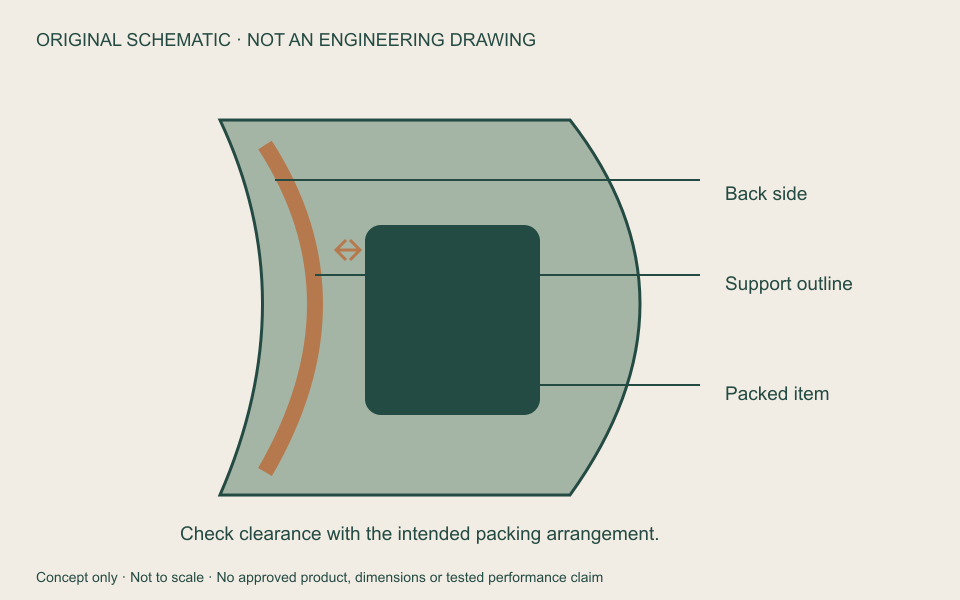
Review backpack internal support alongside packing space and the worn condition. An intended rear outline does not establish room for the target equipment or adequate finishing of hidden ends. Bring back shape, interior positioning and packing interference into the same sample discussion.
01
Identify the support construction
Mark the support reference, orientation, location and visible or concealed areas. Match material and shape records to the actual sample and identify temporary substitutes. For an assembly, define component relationships and installation sequence rather than providing only a rear rendering.
State whether removal, adjustment or bending is intended. Buyers should not infer these permitted actions from a material name.
02
Check clearance with intended equipment
Use a defined packing list and repeatable arrangement. Review items against the support outline, lining, dividers and opening. Rigid equipment, flat devices and soft clothing present different arrangements, so identify the combination being reviewed.
Mark interference by contact location and item direction before discussing a contour or layout change. Increasing bag height is not an automatically verified solution; it can also affect access and opening relationships.
03
Inspect ends and adjacent connections
Review support ends, locating sleeves and nearby seams together. Add internal views, an opened swatch or assembly notes when external photographs conceal these details. Observe unwanted projection, movement or lining contact without inferring durability or safety from photographs.
Reassess the relevant stack after thickness, covering or positioning changes. Retain identification and change records even when a substitute looks similar.
04
Separate standing appearance from worn observations
Wear the bag with an agreed load and adjustment state. Observe the relationship to shoulder straps, waist areas and back-side contact. This is different evidence from an empty standing photograph, and approvals should not substitute one for the other.
Define separate methods and conditions for ventilation, comfort or carrying-performance objectives. A visible gap does not establish a temperature or pressure-distribution result. The schematic explains spatial relationships and does not reproduce a third-party frame design.
05
Keep location-specific approval records
Retain support and bag revisions, equipment list, packing direction, internal photographs and open issues. A hypothetical issue could identify contact between a case corner and the internal outline, then request review using the same packing list after adjustment. “Carrying system approved” should not silently close unfinished interior checks.
Share packing requirements and intended back shape through the JKPD inquiry page to discuss an outdoor backpack sample.
Discuss your bag development project
ANSON XIE
General Manager & Founder
Quanzhou Junkai Pengda Special Equipment Co., Ltd.
Email: ansonxie@jkpdtime.com
Phone: +86 177 5095 3355
WhatsApp: +86 177 5095 3355
Factory address: Floors 2–4, Building 1, Phase I, Huixin Intelligent Manufacturing Industrial Park, Hui'an County, Quanzhou, Fujian, China