
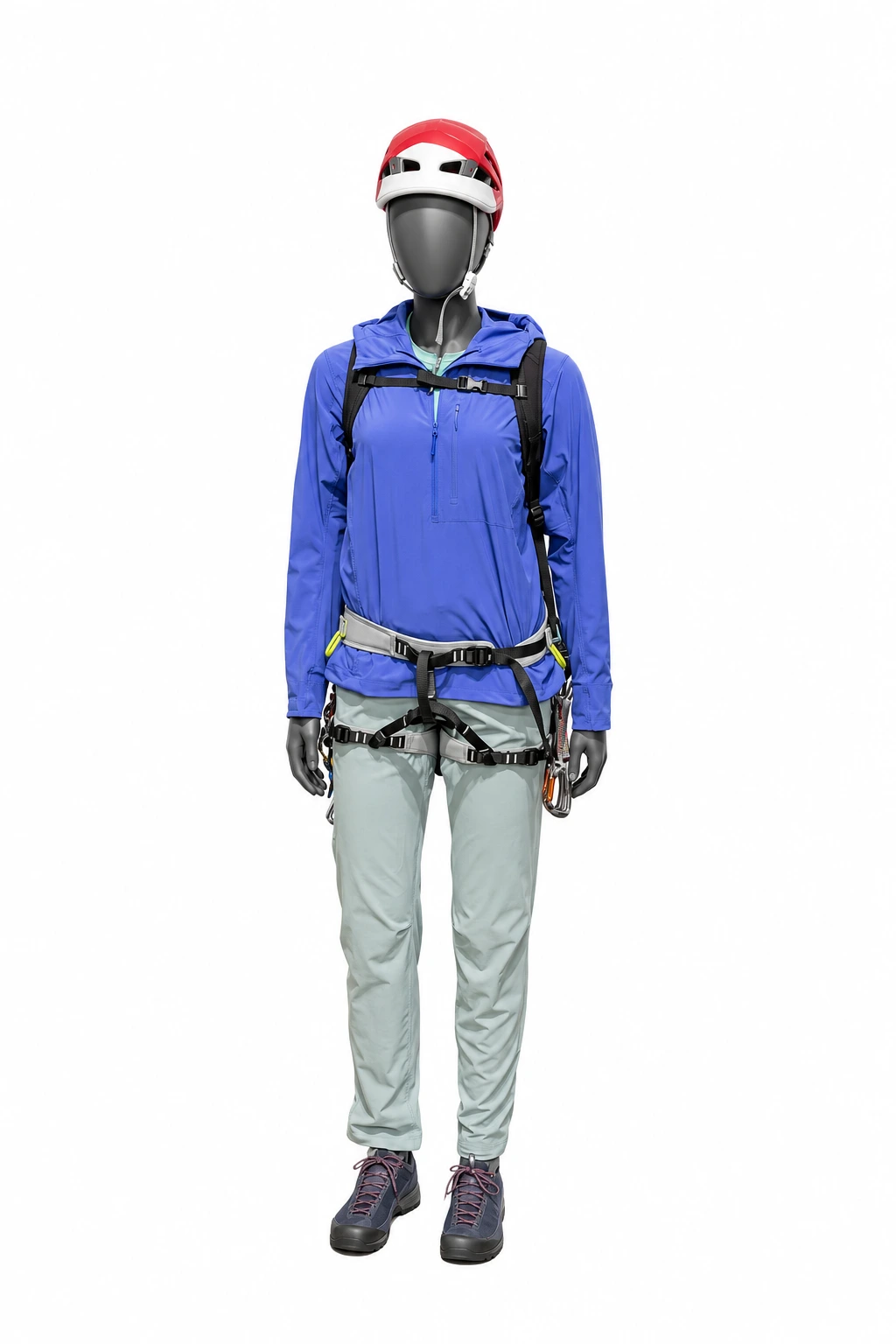
Separate the jobs of a pack belt and a climbing harness. Review waist-area access, clothing layers and any permitted belt-parking configuration together, without treating a static display as proof of compatibility.
Photo: Matti Blume · Source · CC BY-SA 4.0. Ordinary product branding/background cleaned with AI; visible structure reference only. Adaptation under the same license.
01
Give the two systems separate roles
A mountain pack and a climbing harness can occupy the waist area at the same time, while serving different purposes. Pack development should examine whether its belt covers an operating area and how clothing and equipment overlap. Closing both buckles establishes only a static action, not an approved combination.
The blue-jacket exhibition mannequin shows backpack shoulder straps, a chest connection and climbing equipment around the waist and legs. It is not a wearer trial. The image does not establish a pack model, internal support or compatibility; it identifies visible regions that deserve separate attention.
02
Work back from the equipment access area
Identify the positions a user must reach before placing pack pads, tails and pockets around them. With the intended equipment and actual sample, record which component obstructs which approach. Treat the waist as an operating area rather than spare surface on which to add more storage.
A larger pad and a thin webbing belt present different contact layouts. A smaller occupied area does not establish equivalent load support. Review equipment access, intended carrying configuration and body contact together. Thickness or buckle count alone cannot resolve whether a particular interface works for the intended user.
03
Define belt parking as a separate configuration
Some products have specifically designed ways to park or remove a pack belt. Appearance alone cannot establish that option. If a development brief includes it, the design and manufacturing teams must define the interface, permitted states and finished instructions, then review each carrying configuration separately.
Do not redirect important straps through an undesigned loop or transfer another product's instructions to an anonymous reference pack. Describe only confirmed pack functions. Selection, adjustment and use of climbing equipment remain subject to its own manufacturer's instructions and appropriate professional guidance; this article does not explain harness use.
04
Keep the reference configurations distinct
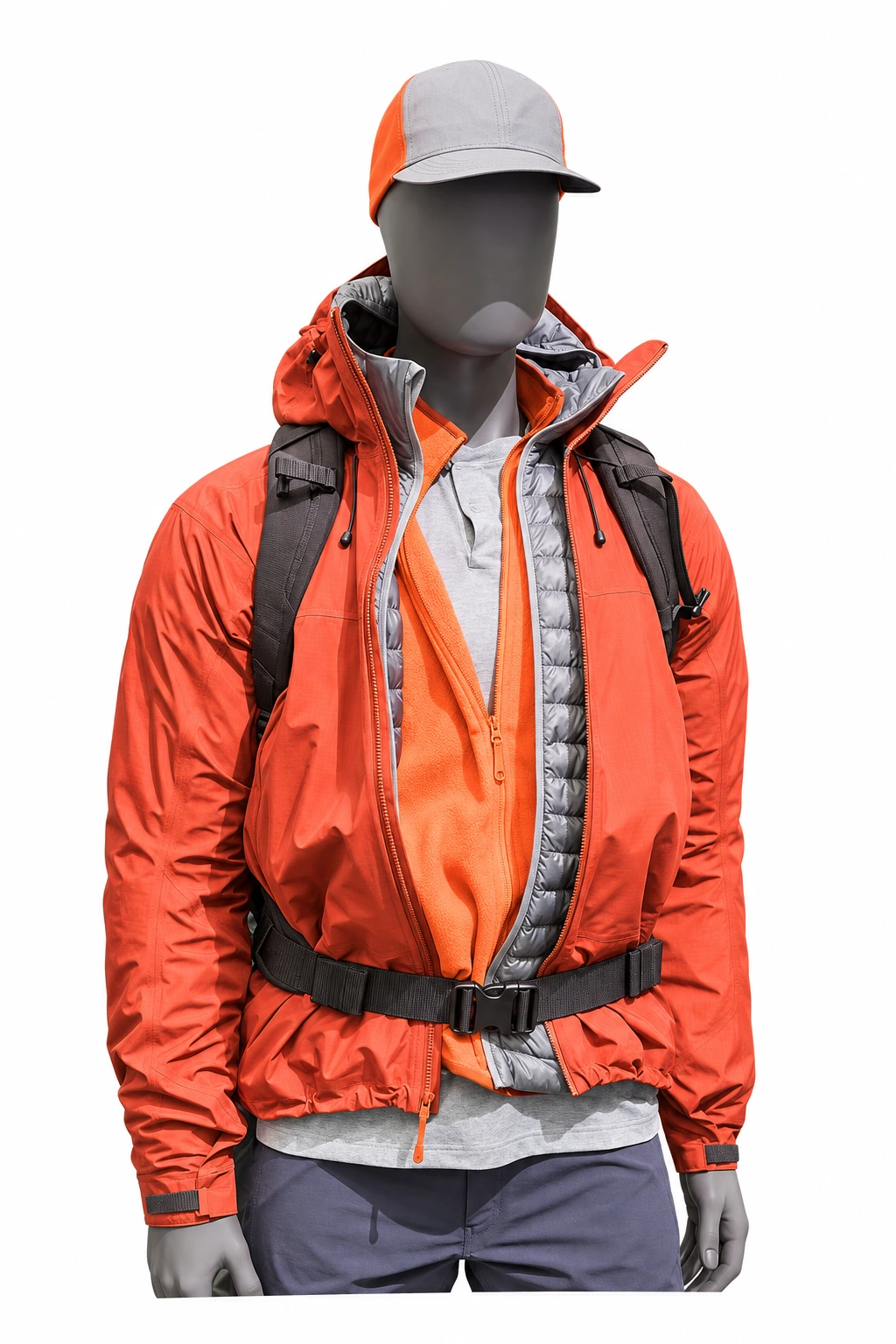
The orange-jacket mannequin shows shoulder straps and a black belt across the abdomen, without the complete climbing arrangement visible in the first image. This is another display configuration, not the first pack after equipment removal. The pair establishes no removable-belt feature or approved harness pairing.
Their value is in documenting what is actually present: clothing layers, visible straps and the areas someone would need to reach. A mannequin's fixed standing pose cannot replace observations of bending, reaching or equipment access. Neither display represents certification or a load-support test.
05
Choose materials around the overlap locations
When waist space is limited, locate the overlapping panels, bindings and buckles before discussing thickness, edge treatment or local materials. Removing a foam layer may change contact area and where the pack rests. That change needs review within the complete carrying configuration, beyond the appearance of a material swatch.
These photographs identify no webbing composition, foam density or abrasion rating. Ask suppliers to propose actual materials for the specified contact, loading and folding regions. Review them in the finished sample. Pixels reconstructed during ordinary brand cleanup show the visible arrangement, not verified textile performance.
06
State the conditions of the interface review
The procurement brief should list permitted pack-belt states, clothing layers, equipment areas requiring access and the combinations actually reviewed. Keep unverified combinations pending instead of claiming general compatibility. A deliberate interface should not depend on users discovering an improvised modification after purchase.
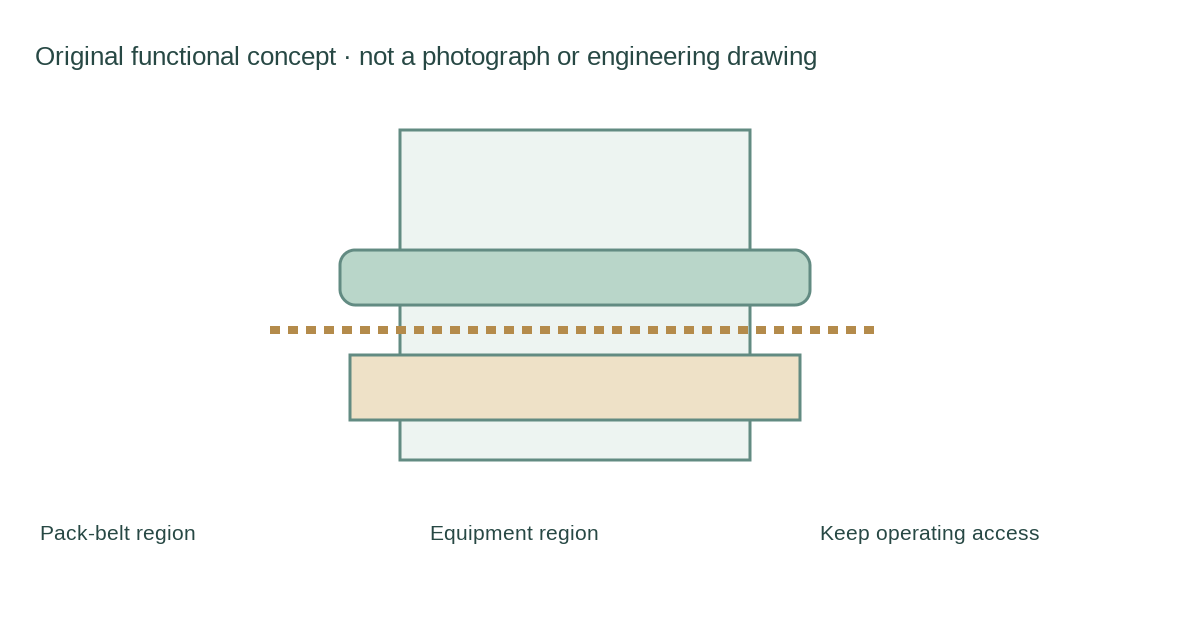
The schematic separates a pack-belt region, another equipment region and an operating area. It is an independent functional concept, without harness fitting instructions, connection points or safety-clearance dimensions. Approval records should retain the configuration and limitations, rather than only a standing display photograph.
Discuss your bag development project
ANSON XIE
General Manager & Founder
Quanzhou Junkai Pengda Special Equipment Co., Ltd.
Email: ansonxie@jkpdtime.com
Phone: +86 177 5095 3355
WhatsApp: +86 177 5095 3355
Factory address: Floors 2–4, Building 1, Phase I, Huixin Intelligent Manufacturing Industrial Park, Hui'an County, Quanzhou, Fujian, China