
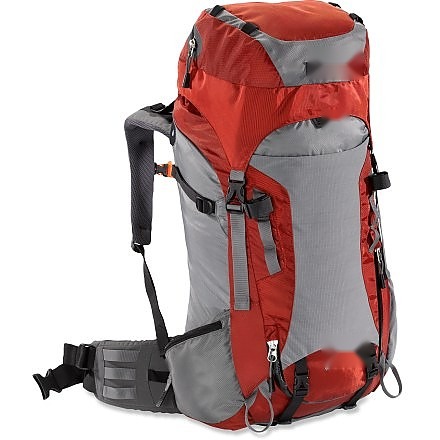
Ultralight packs get most of the attention these days. They are lighter, simpler and better photographed. But a great many hikers still need a pack that does the opposite job: carry a heavy, awkward load — a tent, a stove, food for several days, winter layers, perhaps a share of a group's kit — for long days without hurting. That is the job of the conventional heavy-load trekking pack, and the one in this article is a textbook example.
This reference design is a red-and-grey 65-litre pack. An internal frame, padded belt and top opening are paired with a U-shaped front zip for access to gear under the top layer.
The pack is a reference example, not a JKPD product.
01
At a glance
| Feature | 65 L heavy-load trekking pack |
|---|---|
| Type | Internal-frame trekking pack for multi-day, heavy-load trips |
| Capacity | 65 L |
| Frame | HDPE frame sheet with an inverted-U aluminium tube |
| Back panel | Moulded foam with air channels |
| Main access | Top opening plus a front U-shaped zip covering about three-quarters of the front |
02
Why a conventional heavy-load pack still matters
When the load cannot be cut because the trip is long, the season is cold or the hiker is carrying shared gear, the pack itself must do more work. A firm frame, a shaped hip belt and padded shoulder straps help manage that load.
That work adds weight. The extra structure is most useful when the load is bulky or when lighter suspension would be hard to keep in shape.
03
Functions and features
A frame built for load transfer
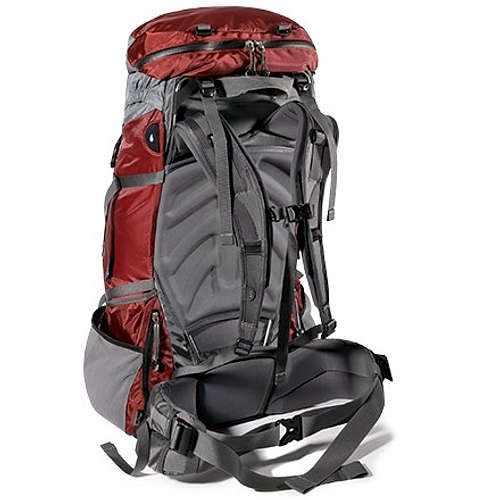
The frame combines two materials. An HDPE (high-density polyethylene) frame sheet gives the back of the pack a stiff, even surface that stops hard objects pressing into the hiker's back and spreads the load across the whole panel. Behind it, an aluminium tube bent into an inverted U runs around the perimeter of the back panel. The tube is what carries the weight down to the hip belt: it keeps the pack from sagging, and it gives the load lifters something solid to pull against.
Check whether the frame perimeter holds its shape under the intended load without impeding movement. A product photo does not establish a load rating.
A hip belt that does the heavy lifting
On a heavy-load pack, the hip belt is the single most important part. The rule of thumb is that most of the load should sit on the hips, not the shoulders, and that only works if the hip belt is thick, well shaped and firmly connected to the frame.
The thick padded belt wraps around the hips rather than sitting flat across them. Rows of attachment webbing leave places for small pouches.
Load lifters, a sliding sternum strap and thick shoulder straps
Load lifters run from the top of the shoulder straps to the top of the frame. Pulling them tight draws the top of the pack towards the hiker's shoulders, which keeps a tall, heavy load from leaning backwards. They only work on a pack with a rigid frame, which is why they are standard on heavy-load packs and often missing on frameless ones.
The sternum strap slides along the padded shoulder straps to change chest height. Confirm any torso adjustment on the loaded sample instead of assuming all sizes fit the same way.
Ventilation through the back panel
The back panel is moulded foam with channels running through it. The channels let air move between the pack and the hiker's back, so sweat can evaporate rather than pooling. It is not as airy as a suspended mesh back, which holds the pack away from the body entirely, but it keeps the load closer to the spine, and on a heavy pack that closeness matters more for stability than the extra airflow.
Storage: lid, main compartment, front pocket and side pockets
- Lid: the top lid has two zipped pockets. Whether there is also an inner pocket under the lid could not be confirmed from the photographs.
- Main compartment: loaded from the top, but also opened by a large U-shaped zip that covers about three-quarters of the front. That front zip is a real advantage on a 65-litre pack: a jacket or a stove packed in the middle can be reached without unloading everything above it.
- Front pocket: a kangaroo-style stash pocket on the front panel, handy for a rain jacket or a map.
- Side pockets: two two-stage side pockets, one on each side, each with a fabric lower section and a stretch-mesh upper section. The fabric lower part protects bottles from abrasion, while the mesh upper part expands to take a larger item.
Lashing points and compression
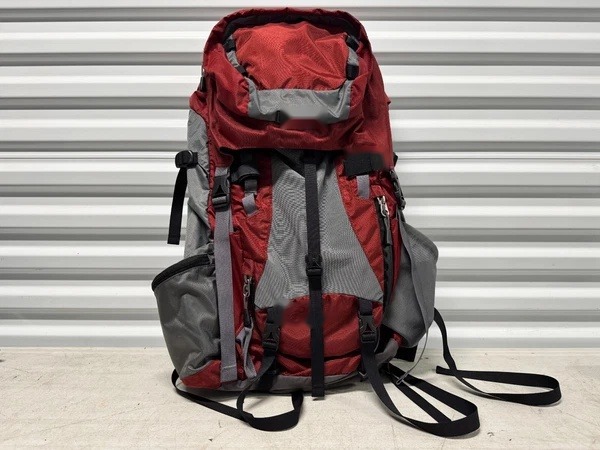
The pack has plenty of places to attach gear outside:
- Four webbing loops on the lid, which can be used to build a custom lashing setup.
- A daisy chain on each side of the front pocket.
- Lower hook-and-loop holders for trekking poles. Note whether the matching upper retainers are present before relying on that carry position.
- Two lashing straps under the base, the classic place to carry a sleeping pad or a tent.
Rain cover
A built-in rain cover is not confirmed. Check the sample before depending on one.
04
Fabric and material combinations
- Body fabric: a heavier woven shell. Confirm the fibre and any finish against the actual fabric specification.
- Frame sheet: HDPE, which supplies a firm backing surface.
- Frame tube: aluminium, bent into an inverted U around the back panel.
- Back panel: moulded foam with air channels.
- Front pocket and upper side pockets: stretch mesh.
- Hardware: black plastic buckles.
The heavier shell, frame sheet and aluminium tube serve different jobs. The shell takes wear; the sheet spreads pressure, and the tube provides a path to the belt.
05
Who is it for?
- Hikers carrying a bulky load that benefits from a firm suspension.
- Multi-day trekkers who need room for a tent, a stove and several days of food.
- Cold-season hikers, whose bulky layers and sleeping bags fill a 65-litre pack quickly.
- Hikers carrying for others, such as a parent carrying a child's kit, or a group member carrying shared gear.
06
Pain points it solves
- Heavy loads on the shoulders. A rigid frame and a thick, wrap-around hip belt move most of the load to the hips.
- Packs that lean backwards. Load lifters pull a tall load back towards the body.
- Digging for items in the middle of the pack. A three-quarter U-shaped front zip opens the main compartment without unloading it from the top.
- Gear that will not fit inside. Lid loops, daisy chains, pole holders and base straps carry bulky items outside.
- Sweaty backs. A moulded foam back panel with air channels lets some air move between pack and back.
07
Design strengths
- A frame that combines a firm HDPE sheet and an inverted-U aluminium tube.
- Thick wraparound hip belt with attachment webbing, plus load lifters, a sliding sternum strap and padded shoulder straps.
- Dual access: top loading plus a large front U-zip.
- Well-organised storage: two zipped lid pockets, a front stash pocket and two-stage side pockets.
- Plenty of external lashing points for a self-customised carry setup.
08
Limitations to keep in mind
- The frame and padding make this pack heavier than a light summer pack.
- Check small hardware for missing or damaged parts, including matching pole holders.
- Rain cover uncertain. Whether a rain cover is included could not be confirmed.
- Lid interior unconfirmed. Whether there is an inner lid pocket could not be confirmed.
- Check for frame bends, compressed belt padding, peeling coating and uneven zip travel.
09
What to inspect on a loaded sample
Stand the packed bag upright to check whether it keeps its shape. Inspect the frame tube for bends and the belt for flattened padding. Operate the long front zip from end to end under load; this is an inspection, not a service-life or load-rating test.
For a lasting design, specify what the frame, belt and shell must each do, and check them where they meet.
10
Prototype brief
Useful inputs for a heavy-load trekking pack prototype include:
- Capacity, target weight and the comfortable load rating the pack should meet.
- Frame design: frame-sheet material, frame-tube or stay layout, and how the hip belt connects to the frame.
- Harness: hip-belt shape and padding, torso adjustment range, load lifters and sternum strap.
- Back panel: moulded foam with channels, or a suspended mesh design.
- Access and storage: top loading, front U-zip, lid pockets, front stash pocket and side pockets.
- External attachments: lid loops, daisy chains, pole holders, base straps and attachment webbing.
- Fabric by zone, including denier, coating, and reinforcement on the base and wear points.
Related guide: Heavy-Load Trekking Packs: What to Check Before Approving the Design
Discuss your bag development project
ANSON XIE
General Manager & Founder
Quanzhou Junkai Pengda Special Equipment Co., Ltd.
Email: ansonxie@jkpdtime.com
Phone: +86 177 5095 3355
WhatsApp: +86 177 5095 3355
Factory address: Floors 2–4, Building 1, Phase I, Huixin Intelligent Manufacturing Industrial Park, Hui'an County, Quanzhou, Fujian, China