
A trail race vest is one of the most demanding products in the whole bag category. It has to carry water, food, a phone and a small jacket, and it has to do this while the runner is bouncing, twisting and breathing hard for hours. A hiking daypack can afford a little movement and a little extra weight. A race vest cannot. If it shifts, it chafes. If it bounces, it wastes energy. If a pocket is in the wrong place, the runner has to stop to reach it, and in a race every stop costs time.
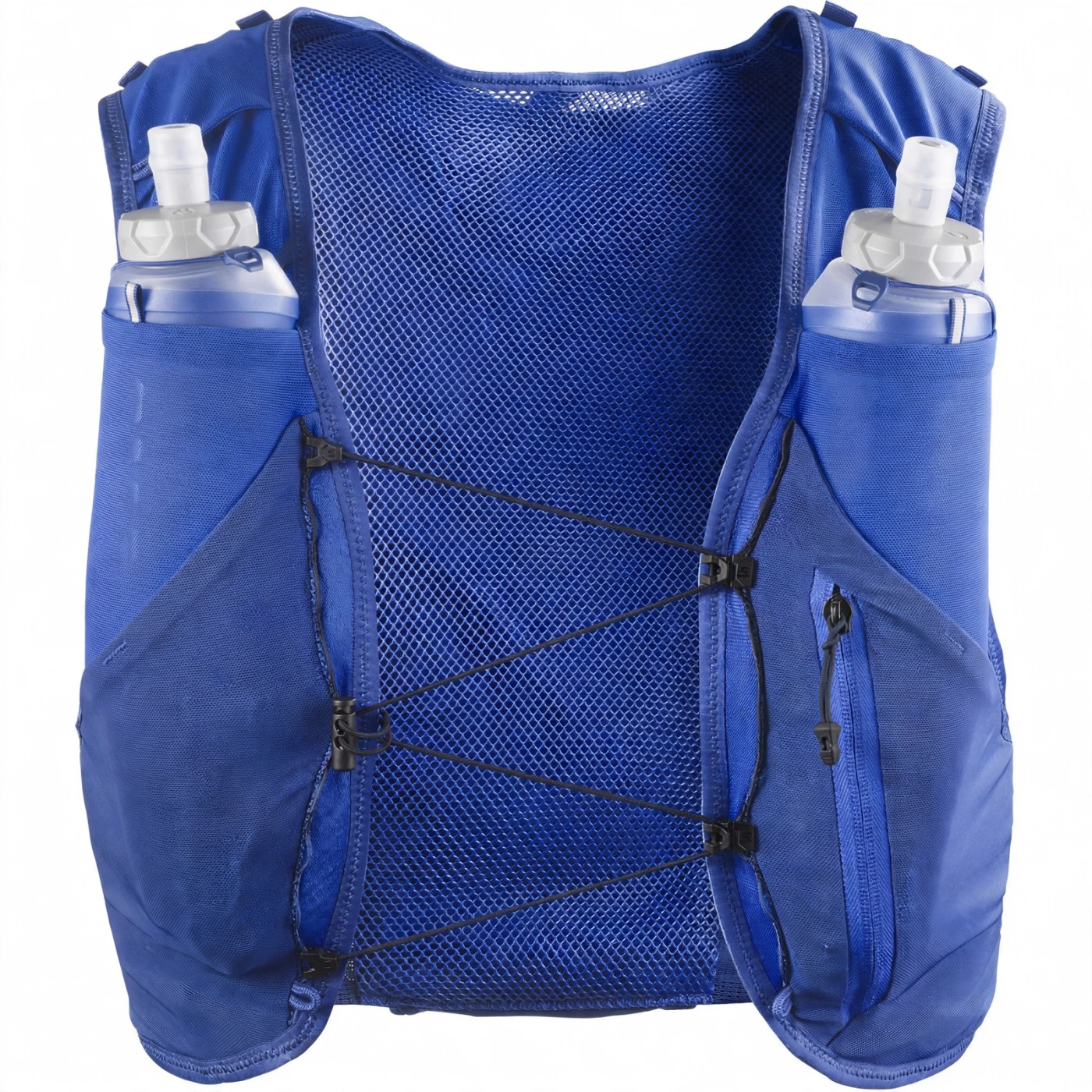
A 5 L race vest is a useful example of the garment-first approach: start with the shape of the runner, then distribute water, food and layers around that fit. The photographs show a reference design, not a JKPD product.
01
At a glance
| Feature | Reference design |
|---|---|
| Type | Close-fitting trail running hydration vest |
| Capacity | 5 L (305 cubic inches) |
| Weight | Approx. 220 g (8 oz) |
| Sizes (chest) | XS 82–89 cm, S 89–96 cm, M 96–103 cm, L 102–109 cm, XL 108–115 cm |
| Front hydration | Two 500 ml soft flasks |
| Reservoir | Rear compartment fits a 2 L reservoir |
| Main fabric | 84% nylon / 16% spandex |
| Back fabric | 100% polyester |
| Foam | 100% polyethylene |
Five litres is a small number, but it is a deliberate one. It is enough for the mandatory kit of many short and medium races (a waterproof jacket, an emergency blanket, a phone, a whistle, some food and about a litre of water) and small enough that the vest behaves like a piece of clothing rather than a bag.
02
Design positioning: a garment first, a bag second
Most backpacks start from a box. The designer decides on a volume, then adds straps to carry it. A race vest works the other way round. It starts from the shape of the runner's upper body and adds storage only where the body allows it.
You can see this in three choices.
First, the fit is set by chest size, not by torso length. Hiking packs are sized by back length because the load sits on the hips. A race vest has no hip belt. The load is spread across the chest, the shoulders and the upper back, so the critical measurement is chest circumference. This vest comes in five chest sizes from XS to XL, with ranges that overlap by a few centimetres so that runners between sizes can choose a snug or a slightly looser fit.
Second, the main fabric stretches. The body uses a nylon and spandex blend (84/16). When the runner breathes in, the vest expands with the rib cage. When the pockets are full, the fabric stretches around the load instead of letting it swing. When the pockets are empty, the fabric pulls back flat. This is the single most important difference between a race vest and a small backpack.
Third, the volume is split into many small places rather than one big compartment. A 5 litre vest with one 5 litre bag would be useless for racing, because everything would sink to the bottom and bounce. Here the volume is divided between chest holsters, front pockets, a lower rear pocket and an upper rear compartment, so each item sits close to the body in its own place. The result is a product that is closer to a technical running top with pockets than to a traditional pack.
03
Functions and features
Chest holsters for soft flasks
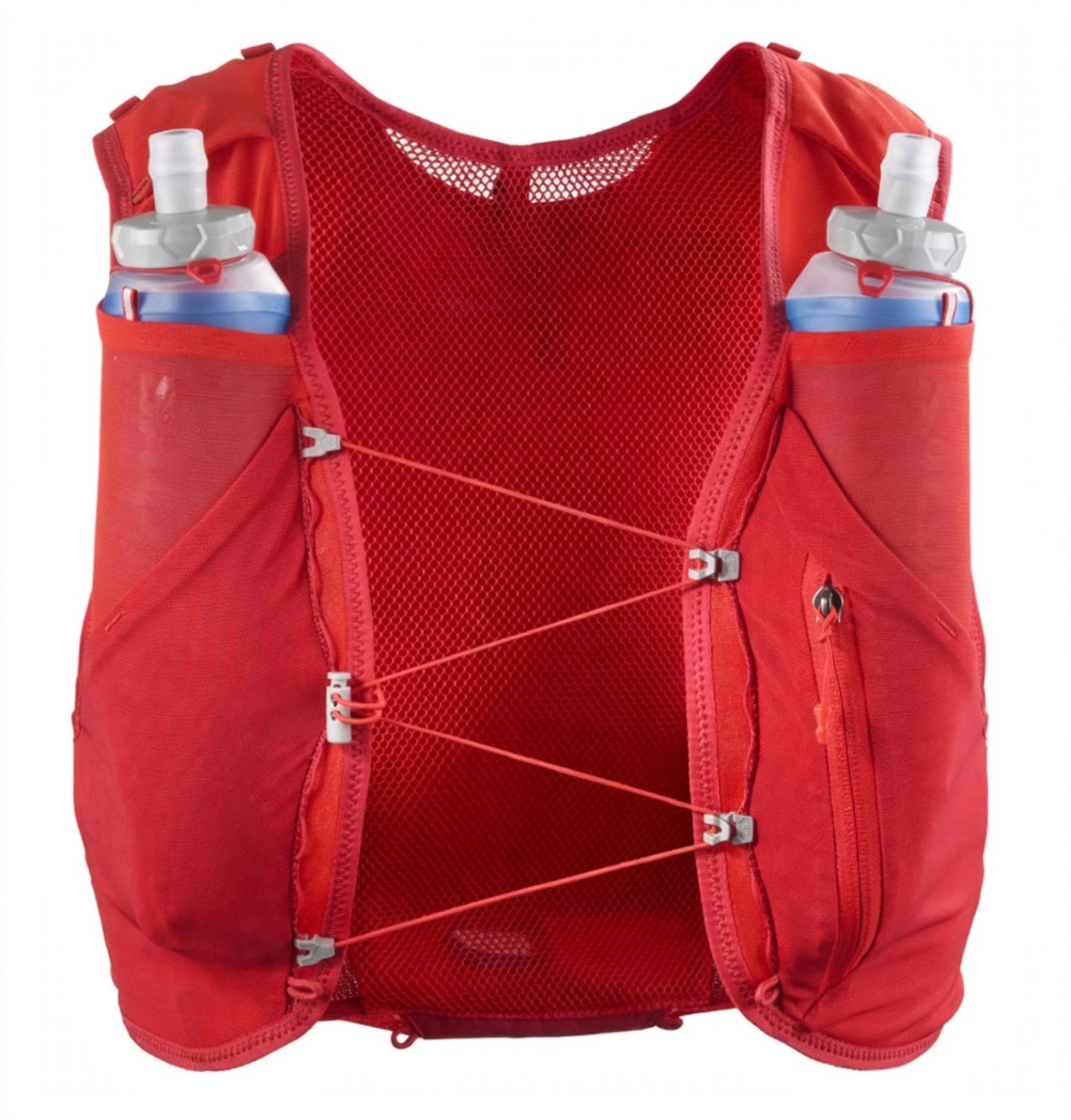
Two tall chest holsters, each about 9 × 20 cm, are sized around 500 ml soft flasks.
Soft flasks collapse as they empty. The high holsters bring the bite valves within reach and keep a full litre of water closer to the torso. Check whether partly empty flasks settle below the usable reach point.
Inside the right-hand holster there is a small additional pouch, useful for a gel, salt tablets or a small piece of race kit.
Large front dump pockets
Outside each holster sits a larger stretch pocket of about 17 × 15 cm. These are the "dump pockets" of the vest: places to push a used gel wrapper, a pair of gloves, a buff or a light hat while running. They are open-topped stretch mesh, so they can be used with one hand without slowing down.
Zipped front pocket
On the front left there is a zipped pocket of about 17 × 15 cm. This is the secure place on the vest, suitable for a phone, a car key or anything the runner cannot afford to lose on a technical descent. Having at least one zipped pocket on the front is now considered essential on race vests, because many races require a phone to be carried and reachable.
Lower rear through-pocket
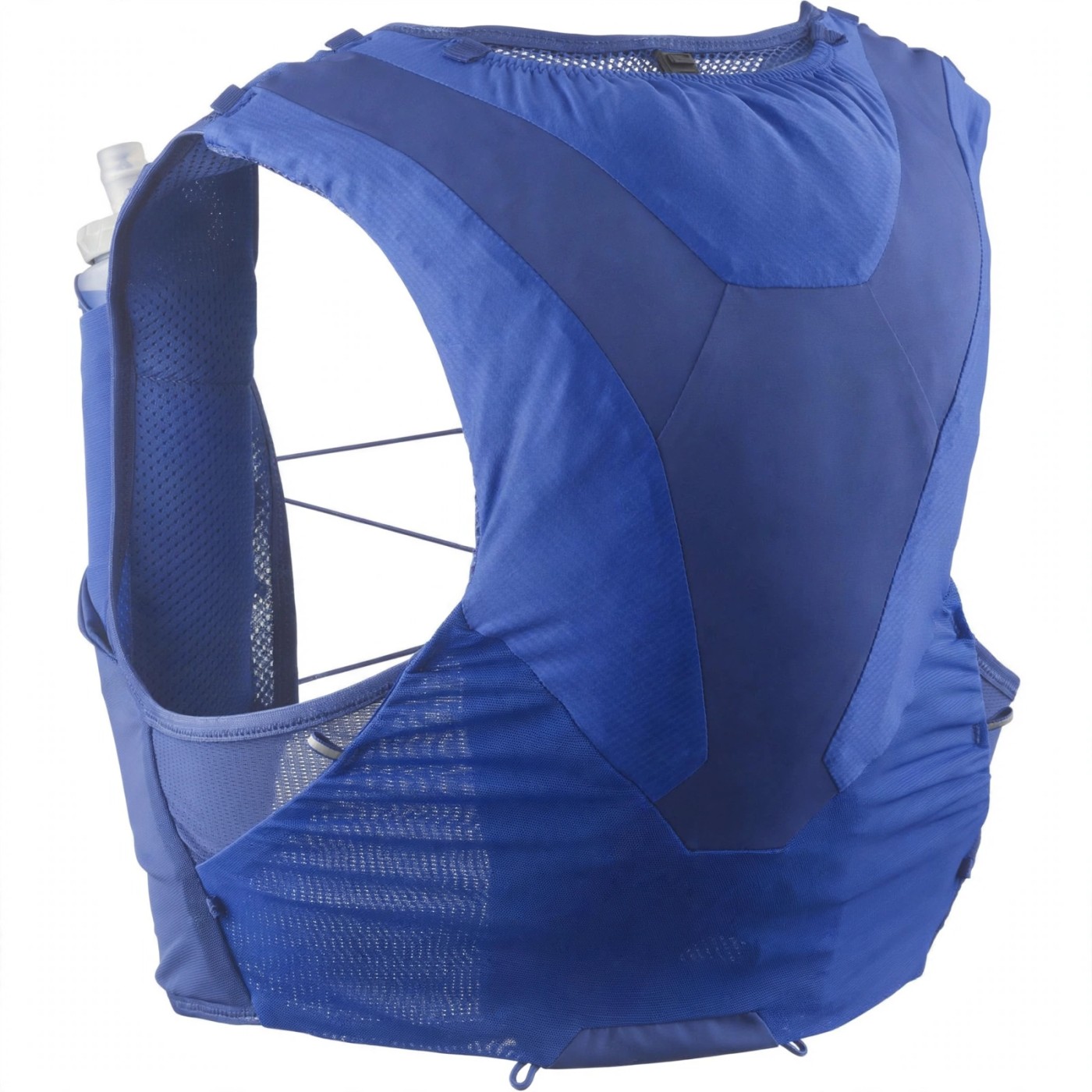
Across the lower back runs a large pocket of about 38 × 19 cm that can be reached from both sides. This is a smart solution to a real problem: runners cannot easily reach behind their backs while moving, but they can reach around to their sides. By opening the pocket at both ends, the designer lets the runner slide a jacket or a pair of arm sleeves in and out from the left or the right without taking the vest off.
Upper rear compartment
Above it is an approximately 18 × 33 cm compartment for bulkier kit such as a shell or emergency blanket. The compartment can also accommodate a 2 L reservoir. A small mesh pouch with a key clip separates valuables.
Front closure system
Instead of two rigid sternum straps with plastic buckles, the front panels are joined by a cross-laced elastic cord that hooks into small fabric loops and low-profile hooks. This design has two benefits. It distributes tension along the whole front of the vest rather than at two points, and it fits a wide range of chest shapes, which is why it suits both men and women.
Trekking pole holder
Many mountain races allow poles, and runners often carry them folded during flat or downhill sections. The vest includes a holder for folding poles, so they can be stowed without hand-carrying.
Safety details
The vest has reflective details on all sides for visibility in low light, and an emergency whistle on the left shoulder. A whistle is mandatory kit in many mountain races, so building it into the vest means one less item to forget.
04
Fabric and material combinations
A race vest uses fewer materials than a hiking pack, but each one is chosen for a very specific job.
Main body: an 84/16 nylon and spandex stretch knit in this example. Nylon supplies strength; spandex helps the knit return after it stretches. A sample should recover after repeated loaded use, not just feel stretchy when new.
Back panel: 100% polyester. The back panel sits against the runner's shirt for hours. Polyester absorbs very little water, dries quickly and keeps its shape when wet, which is why it is the usual choice for the surface that carries the most sweat.
Foam: 100% polyethylene. A thin layer of PE foam is used where structure or a little padding is needed. Polyethylene foam is light, does not absorb water and keeps the vest from feeling like wet towelling after a long run.
Mesh in the chest area. Large areas of open mesh on the front and in the pockets cut weight and improve ventilation. Open mesh also lets the runner see what is in each pocket.
Cord, hooks and small hardware. Thin elastic cord, low-profile hooks and fabric loops distribute the closure tension. Compare the complete closure for weight, wet grip and pressure under load.
05
Who is it for?
Short and middle-distance trail racers. The obvious user is a runner doing races from around 10 km to 50 km, where about one litre of water and a light set of mandatory kit is enough between aid stations.
Sky runners and fast mountain runners. On steep, technical terrain, a vest that does not move matters more than extra capacity. A 5 litre vest with a close fit lets the runner move freely on climbs and descents.
Training runners. Many runners use the same vest for long training runs of two to four hours, carrying water, a phone and a jacket.
Chest shapes vary. Try the overlap between sizes with both flasks full, then check where the lacing crosses the chest on different fit models.
It is less suitable for runners doing 100 km or 100 mile races with large mandatory kit lists, or for anyone who needs to carry a lot of warm clothing in winter. They usually need a vest of 10 to 15 litres.
06
Pain points it solves
Bounce. A loose or rigid pack moves up and down with every step. The stretch body and close chest fit keep the load against the torso, so there is very little bounce even with full flasks.
Chafing. Rigid straps and hard buckles rub on the collarbone and the ribs over long distances. The soft, stretchy body and the cord closure reduce pressure points.
Water access. Bottles in side pockets or a reservoir alone make it hard to know how much water is left. Soft flasks on the chest let the runner see and reach their water at all times.
Overheating. A large padded back panel traps heat. The polyester back panel and large mesh areas on the front help the vest breathe.
Reaching kit while moving. The double-entry lower rear pocket and the front dump pockets give the runner access from the sides without removing the vest.
Fit across chest shapes. Cross-lacing spreads tension along several points; check that the cord clears concentrated pressure areas and allows a deep breath.
07
Design strengths
- Very low weight for the feature set. Around 220 g for a vest with two flasks' worth of holsters, a zipped pocket, two large rear compartments and a pole holder.
- Clothing-like fit. The nylon and spandex blend gives a close, stable fit, so the vest feels worn rather than carried.
- Water at the front. The chest holsters are sized for two 500 ml soft flasks; the rear compartment can accommodate a 2 L reservoir.
- Smart pocket layout. Every pocket has a clear job, and most can be used while running.
- Race-ready safety features. Reflective details on all sides and an integrated whistle.
- Wide size range. Five chest sizes from 82 cm to 115 cm.
08
Limitations to keep in mind
Small capacity. Five litres is enough for a short race, but not for long ultras with heavy mandatory kit lists or for cold-weather running with extra layers.
Fit sensitivity. Because the vest relies on a close fit, choosing the wrong size matters more than with a traditional pack. Runners between sizes need to think about whether they prefer snug or relaxed.
Delicate materials. Light stretch fabrics and open mesh are less resistant to abrasion than heavier pack fabrics. Contact with rock, thorny vegetation or rough surfaces can damage them more quickly.
09
Design lessons
Design the vest around the body, not the volume. Start with chest size and movement, then decide how much can be carried without compromising fit.
Use stretch fabrics with real recovery. A higher spandex content is what turns a small bag into a vest. The fabric needs to stretch with breathing and return to shape after thousands of cycles.
Put water on the chest. Chest holsters sized for soft flasks are now the standard layout for trail racing. A rear reservoir is a useful option, not a replacement.
Split the volume. Many small, clearly assigned pockets are more useful than one large compartment. Think about what the runner needs to reach while moving, and put those pockets at the front or the sides.
Remove hard hardware where possible. Elastic cord closures, fabric loops and small hooks can replace heavy buckles and reduce pressure points. Build safety into the product. Reflective details and a whistle are low-cost features that matter a lot in mountain races.
Plan a clear size chart. Close-fitting products live or die by their sizing. Overlapping chest ranges help runners between sizes.
10
Development checklist
Record these inputs on the sample brief before approving the layout:
- Target capacity, target weight and the races or distances the vest is designed for.
- Size range and chest measurements for each size.
- Fabric choices by zone: stretch body, back panel, mesh areas and foam.
- Hydration layout: soft flask size and number, and whether a reservoir sleeve is needed.
- Closure system: elastic cord, sternum straps or another solution.
- Pocket list with approximate sizes and opening directions.
- Safety and accessory details, such as reflective trims, a whistle and a pole holder.
- Colourways.
Related guide: Trail Vest Pockets: Where Do Used Gel Wrappers Go?
Discuss your bag development project
ANSON XIE
General Manager & Founder
Quanzhou Junkai Pengda Special Equipment Co., Ltd.
Email: ansonxie@jkpdtime.com
Phone: +86 177 5095 3355
WhatsApp: +86 177 5095 3355
Factory address: Floors 2–4, Building 1, Phase I, Huixin Intelligent Manufacturing Industrial Park, Hui'an County, Quanzhou, Fujian, China