
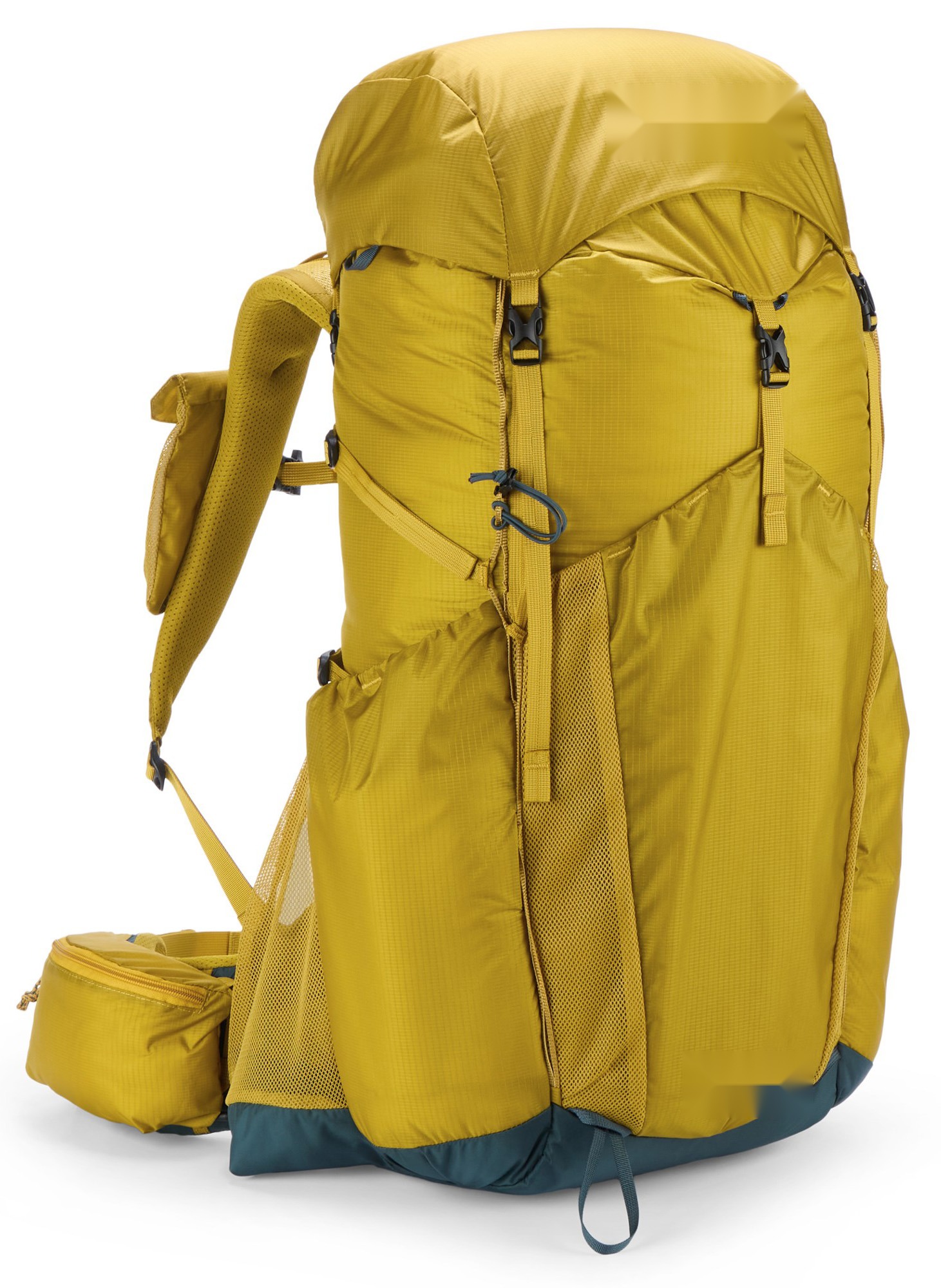
This roll-top trekking pack keeps its steel perimeter frame installed while allowing the lid, external pockets and compression straps to be removed or repositioned.
The design uses a sliding shoulder yoke and two different side pockets on each side. Treat each removable attachment as a separate part of the packing and fit brief.
01
At a glance
| Feature | S | M | L |
|---|---|---|---|
| Volume | 53 L | 55 L | 57 L |
| Dimensions | — | About 36 × 76 × 31 cm | — |
| Torso length | 43–48 cm | 46–51 cm | 48–53 cm |
| Hip-belt size | 81–102 cm | 86–107 cm | 86–117 cm |
| Frame | Internal spring-steel perimeter wire, not removable | Same | Same |
| Main fabric | 100-denier recycled ripstop nylon | Same | Same |
| Secondary fabric | 210-denier recycled high- tenacity nylon | Same | Same |
02
Why this pack matters: a pack you can take apart
No single configuration is right for every trip. A weekend walk needs a lid and pockets. A fast overnight with a light load needs none of them. Most packs force the owner to carry the full feature set regardless; this one lets the owner choose.
Removable parts include the floating lid, pockets at the belt and shoulder, and compression straps. Mark which straps must remain when the pack is carried without the lid.
Just as important as removal is repositioning. The straps are not sewn into the seams: they girth- hitch onto cord daisy chains down the sides of the pack, so a compression strap can be moved or repurposed. That is the difference between a pack with removable parts and a pack with a genuinely modular system.
03
Functions and features
The removable accessory system
The lid is a floating lid: it sits above the roll-top on straps, so it can rise to cover a tall load or wedge gear — a bear canister, a tent, a sleeping pad — between the top of the main compartment and the bottom of the lid. A large canister also fits vertically inside the main compartment, and smaller ones fit horizontally at the bottom of it or in the extension collar.
A webbing-and-toggle connection attaches the hip-belt pockets. Try a pocket with its intended contents on a worn belt to see whether the toggle and pocket mouth are accessible.
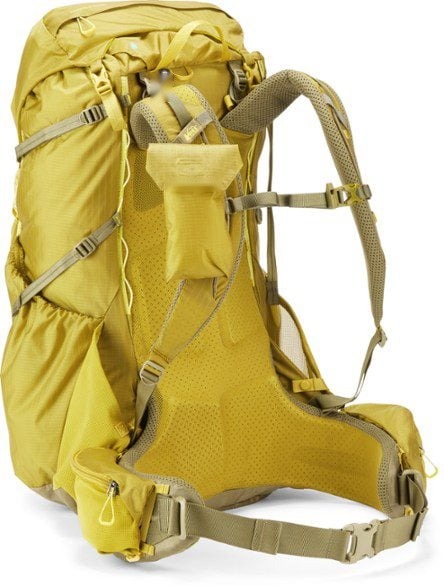
Roll-top closure and the extension collar
The main compartment closes with a roll-top: lighter than a zipped lid, it keeps rain out of the top and changes volume easily — roll it down on a light day, extend it after a resupply. The roll-top ends can be clipped along the sides of the pack, and the long extension collar rises above the frame, which is why the floating lid matters: a fixed lid could not follow it.
Inside, the main compartment is a single unstructured tube with top access only. There is no lower zip, so packing order matters: the things needed last go in first. An internal hydration sleeve with a central hang loop sits inside, with a hose port to the outside. A rain cover is not included, so a pack liner is recommended.
Two pockets on each side
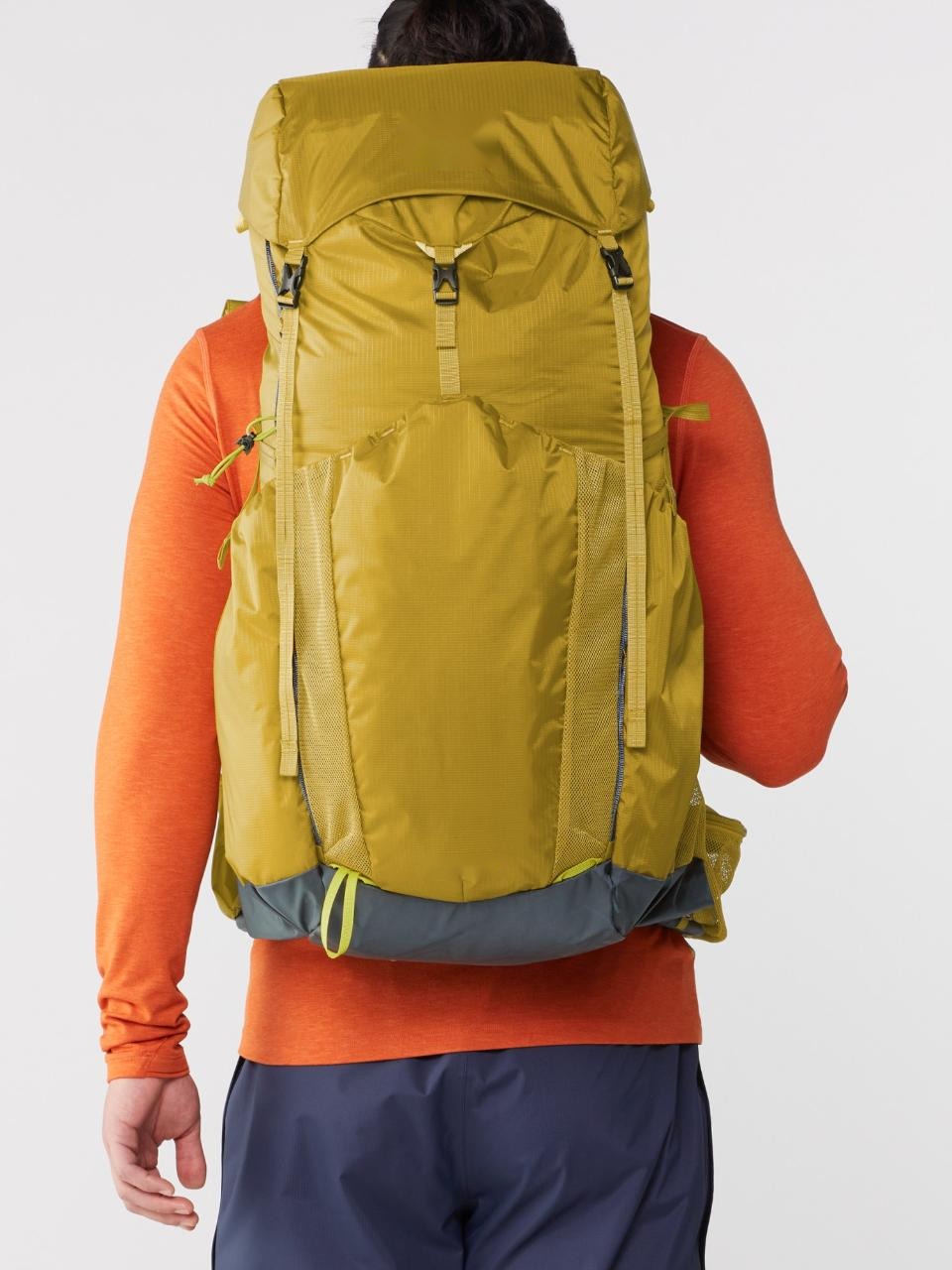
The side pocket layout is unusual and worth describing carefully, because it is easy to miscount. Each side has two pockets: a mesh water-bottle sleeve at the front, and a solid pocket behind it.
The mesh sleeves angle forward just behind the belt. Try withdrawing and returning the intended bottle with the snap and adjacent strap in their working positions. The taller solid pockets sit farther back and are better suited to items that do not need to come out while the pack is worn.
Front pocket, daisy chains and pole carry
The front pocket is a solid stretch pocket bordered on the sides with durable mesh, so damp or frequently used items can be stowed without opening the pack, and wet items can drain and dry. Its top hooks onto a small plastic fitting for added security.
Daisy chains run along both sides of the front pocket and up the side seams to the top of the frame — cord loops rather than traditional webbing, a detail borrowed from trail-running packs. They anchor the movable compression straps and serve as lashing points for gear such as snowshoes, and the pack also carries a tool keeper for trekking poles and ice axes at the front.
Adjustable torso and the steel perimeter frame
The shoulder yoke adjusts along horizontal webbing on the back panel. Use the markings to record the position, then check the same position with the pack loaded. Verify the fitting range on each size.
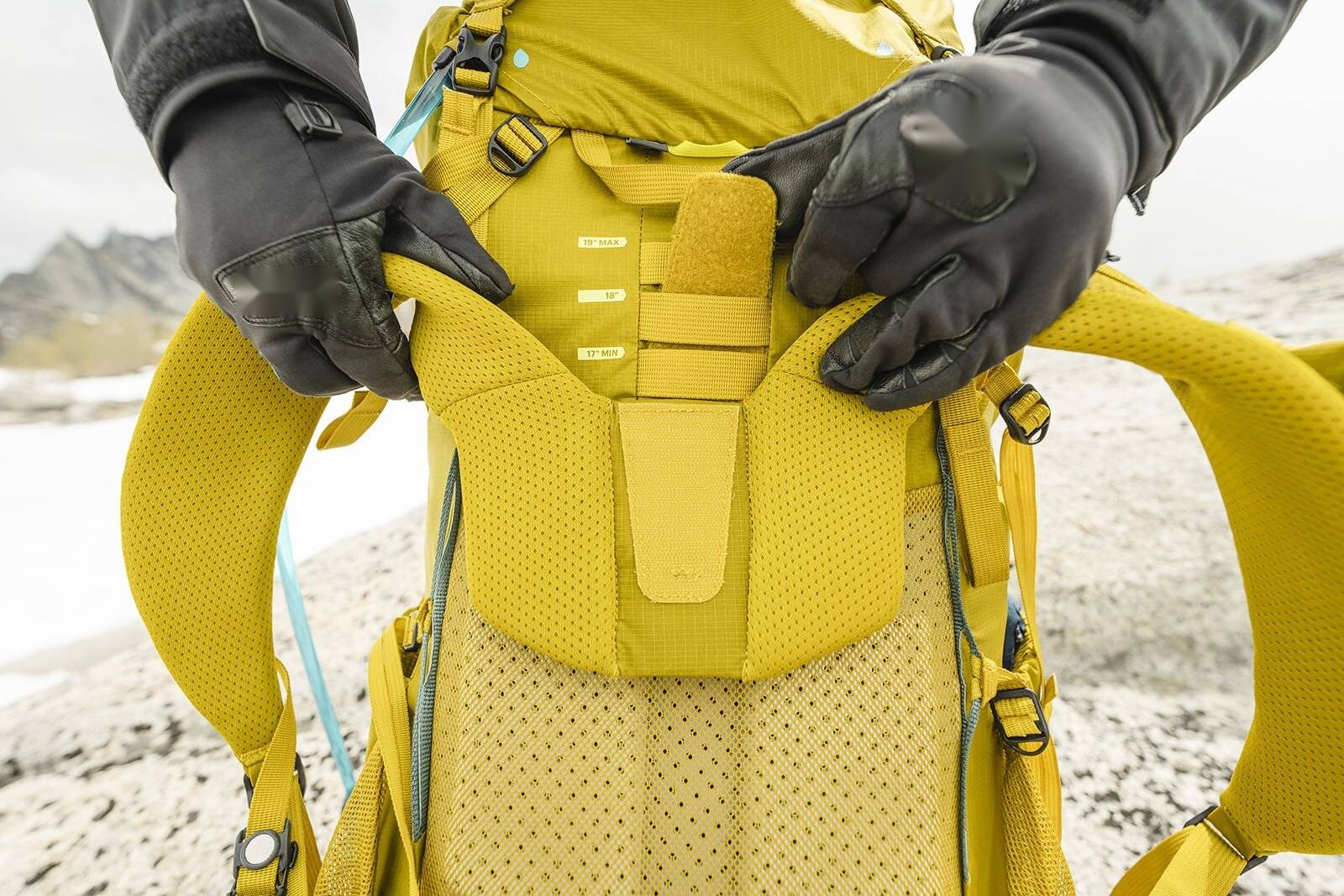
The steel perimeter frame stays installed. Its upper attachment gives the load lifters a structural anchor, and the contoured belt provides a contact area at the hips. Check the frame, attachment and lumbar contact together.
The back panel is mesh stretched across soft padding, which keeps the wearer's shirt drier in warm weather than a solid foam panel, though it is not as ventilated as a fully suspended mesh back. The shoulder straps are thickly padded, J-shaped, covered in breathable mesh, and carry elastic hose keepers plus the short webbing straps for the accessory pocket. The sternum strap slides on a rail for height adjustment and carries a whistle. The hip belt closes with pull-forward straps and a single central buckle, which works with gloves on and does not clog with snow the way smaller buckles can.
04
Fabric and material combinations
The fabric choice is deliberately ordinary in the best sense: proven, recycled nylon, used in two weights where each is needed.
- Main body: lightweight nylon ripstop. Confirm recycled content and finish against the actual fabric specification.
- Secondary panels and base: 210-denier recycled high-tenacity nylon, used where the pack takes more abuse.
- Front and side pockets: stretch mesh, keeping weight down and letting wet items drain; the front pocket has a solid face with mesh only at the sides, so items lashed to the front do not press through mesh.
- Back panel and straps: foam padding covered in breathable mesh, with a contoured, pre- curved hip belt.
- Frame: a single spring-steel perimeter wire, internal and non-removable.
- Hardware: zips, buckles and cord fittings from specialist suppliers, sized for gloved use where it matters.
Shell water resistance does not cover sewn seams, closures or all load states. Check the finished sample and use a separate liner for contents that need one.
05
Who is it for?
- Backpackers moving from a conventional pack to lightweight gear, who want a frame, load lifters and a real hip belt.
- Hikers still refining their kit, who value being able to remove, move or add pockets and straps as their setup changes.
- Hikers who need torso adjustment within a size or want to compare adjacent sizes with the same load.
- Hikers with a tall rigid item; check that it fits the main opening or the intended lid interface without pulling its straps off-axis.
06
Pain points it solves
- The lid, accessory pockets and selected straps can be repositioned or removed without moving the main frame.
- The sliding yoke adjusts torso length over a defined range. Check the minimum and maximum fit conditions.
- Bottles that cannot be reached while walking. The angled mesh sleeves sit just behind the hip belt, so a bottle can be pulled out and replaced without taking the pack off.
- Awkward loads with nowhere to go. The floating lid, the extension collar, the daisy chains and the movable compression straps give options for a canister, a tent, a sleeping pad or snowshoes.
07
Design strengths
- A genuinely modular system, not just removable parts: lid, hip-belt pockets, shoulder-strap pocket and compression straps all detach, and the straps reposition along cord daisy chains.
- A fixed steel perimeter frame with upper load lifters.
- Ten pockets in full configuration, including two mesh bottle sleeves and two solid side pockets.
- A floating lid that can cover a taller load; verify strap travel and entry clearance with the chosen equipment.
08
Limitations to keep in mind
- Treat the sewn bag as distinct from the shell fabric's water-resistance result.
- Open mesh can catch on rough surfaces. Check the bottle-sleeve edge and the front pocket at likely contact points.
- Top access only. There is no lower zip into the main compartment, so packing order has to be planned.
- With side straps removed, there is less control over bulky items in the side pockets. Check which restraints are necessary for the intended load.
- The sliding yoke fine-tunes fit within each size, rather than replacing size selection.
09
What the design teaches
The most useful lesson in this pack is that modularity is a system, not a feature list. Removable pockets are common; what makes this pack different is that the attachment points are part of the design — cord daisy chains down the sides, a toggle system for the pockets, a yoke that slides on a marked scale. Because the pack was designed around parts that move, removing them does not leave a crippled pack behind.
Specify usable main-compartment capacity separately from external pockets and collar expansion.
The light setup still needs enough straps to control the intended load. Compare the same pack with and without its removable parts before approving a configuration.
10
Prototype brief
Useful inputs for a moveable-lid and pocket system include:
- Target weight, capacity and recommended maximum load, in full and stripped configurations.
- Modularity: which parts detach, how they attach, and whether straps reposition along the pack.
- Frame design: wire or stay material and shape, how the frame sits in the back panel, and how the load lifters connect to it.
- Fabric by zone: ripstop nylon weights for the body, heavier nylon for the base and lid, mesh for the pockets, and the water-resistance target — including whether seams should be taped.
- Closure and access: roll-top volume, floating-lid height, and the split between the main compartment and the pockets.
- Pocket layout: bottle-sleeve angle and size, front pocket construction, hip-belt pockets, and hydration options.
- Sizing: torso lengths and hip-belt sizes, and which sizes the line should cover.
Related guide: Hiking Pack Load Lifters: Start with Anchor Geometry
Discuss your bag development project
ANSON XIE
General Manager & Founder
Quanzhou Junkai Pengda Special Equipment Co., Ltd.
Email: ansonxie@jkpdtime.com
Phone: +86 177 5095 3355
WhatsApp: +86 177 5095 3355
Factory address: Floors 2–4, Building 1, Phase I, Huixin Intelligent Manufacturing Industrial Park, Hui'an County, Quanzhou, Fujian, China