
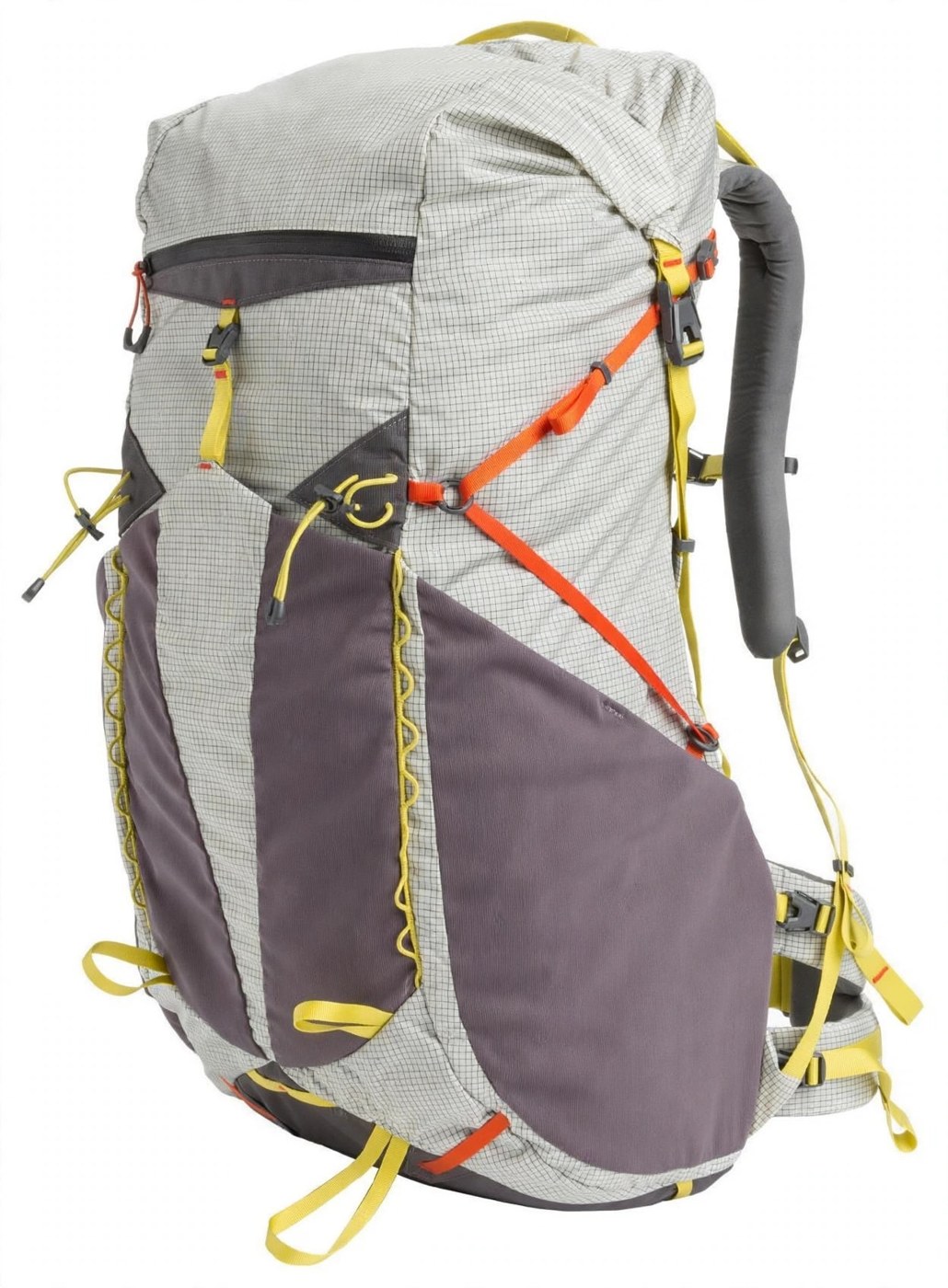
The colours on this 50 L reference pack follow the construction: a pale central body, darker side and base panels, and brighter touches at controls. The same pack also offers a useful look at how an adjustable back can coexist with rear entry.
This analysis separates the jobs of visibility, access, fit and material zoning. The pictured pack is a reference design, not a JKPD product.
01
At a glance
| Feature | Reference design |
|---|---|
| Type | Adjustable lightweight backpacking pack for long-distance and heavier loads |
| Capacity | 50 L |
| Weight | M 1.39 kg / L 1.45 kg |
| Torso (back) length | M 46–51 cm / L 51–56 cm |
| Hip belt range | M 81–137 cm / L 89–147 cm |
| Dimensions | M 84 × 25 × 20 cm / L 89 × 24 × 20 cm |
| Top opening | 43 cm |
| Frame | Aluminium frame with integrated shoulder strap and hip belt suspension |
| Main fabric | High-tenacity ripstop nylon |
| Removable storage | 7 L pouch for waste or wet items |
02
The colour scheme, explained
The pack looks colourful, yet it never looks messy. That is because the palette follows a clear structure.
- Three main body colours. A light grey-white grid fabric forms the central panels. A dark purple-grey fabric covers the large side and front panels. A darker charcoal is used at the base and in the harness.
- Two accessory colours. The webbing and the bungee cord are picked out in a bright yellow and an orange-red.
In total, five colours are used, but each one has a job. The neutral body colours carry most of the visual weight. The bright accents mark the parts the user touches and adjusts: straps, cords, zip pulls and attachment points. That makes the pack easy to read at a glance. You see immediately where to pull, clip or tighten.
Colour blocking works best when the colours follow seams and functions. Dark base panels can disguise scuffs; bright hardware accents help distinguish the parts a hiker needs to find with gloved hands. The ripstop grid is a texture as well as a visible structure.
03
Functions and features
Behind the colour is a long list of practical features.
Height-adjustable lower back panel
The pack's suspension lets the user raise or lower the lower back panel to match their torso length. Each size covers a five-centimetre range (M 46–51 cm, L 51–56 cm). A good fit is the single most important factor in carrying comfort, and an adjustable back means the pack can be tuned rather than simply chosen by size.
Aluminium frame with integrated suspension
An aluminium frame connects to the shoulder straps and hip belt through an integrated suspension. The belt passes through the lower panel. Check that weight reaches the belt at each torso setting, without relying on shoulder tension alone.
Ergonomic back pad with full-length zip access
The back panel has an ergonomic padded design. It also opens with a full-length zip, giving direct access to the main compartment from the back. The user can reach gear at the bottom of the pack without unloading everything from the top.
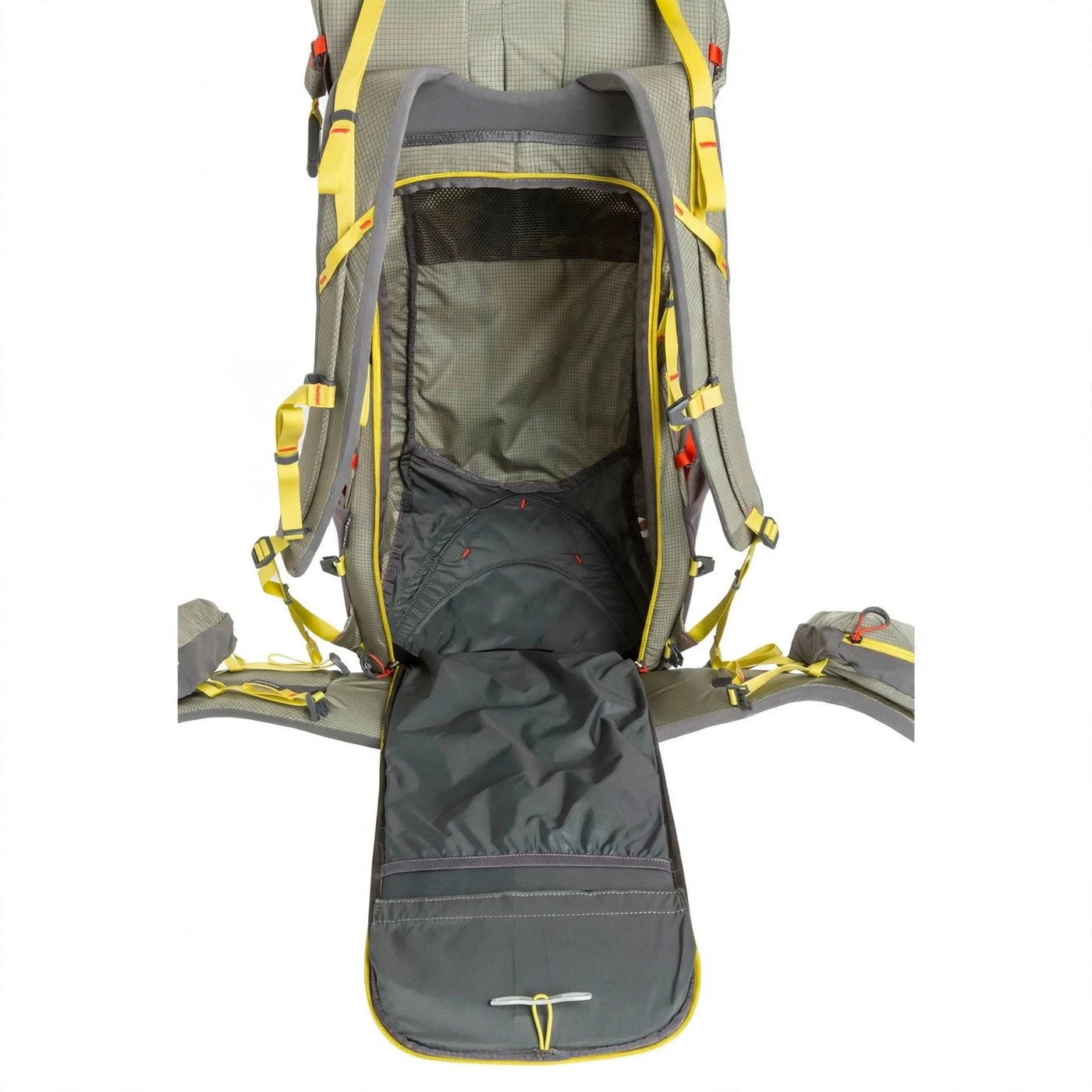
Harness details
- Soft, padded shoulder straps.
- A clip to hold a hydration tube in place.
- An adjustable sternum strap.
- Load-adjustment straps to tune the pack's centre of gravity.
Pockets and storage
- One hydration sleeve inside, sized for a 3 L reservoir, with a port for the drinking tube.
- Two side mesh pockets.
- One front stash pocket for layers and quick-access items.
- A small zipped pocket and key clip separate loose essentials.
- Hip-belt storage totalling 1.6 L.
Attachment points
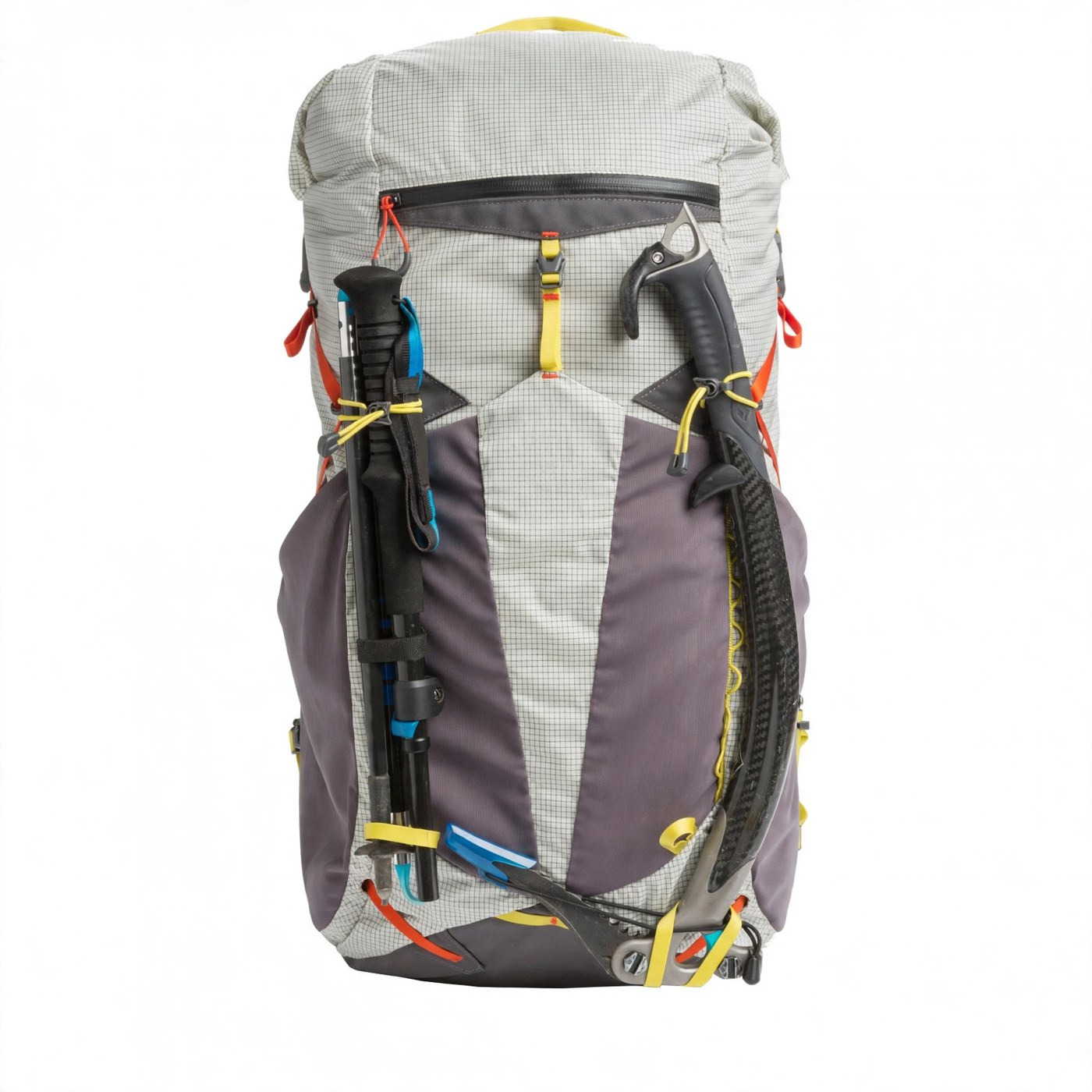
- Two bungee cord attachments with webbing on the front for trekking poles or an ice axe.
- A daisy chain for clipping extra gear.
- A top carry handle.
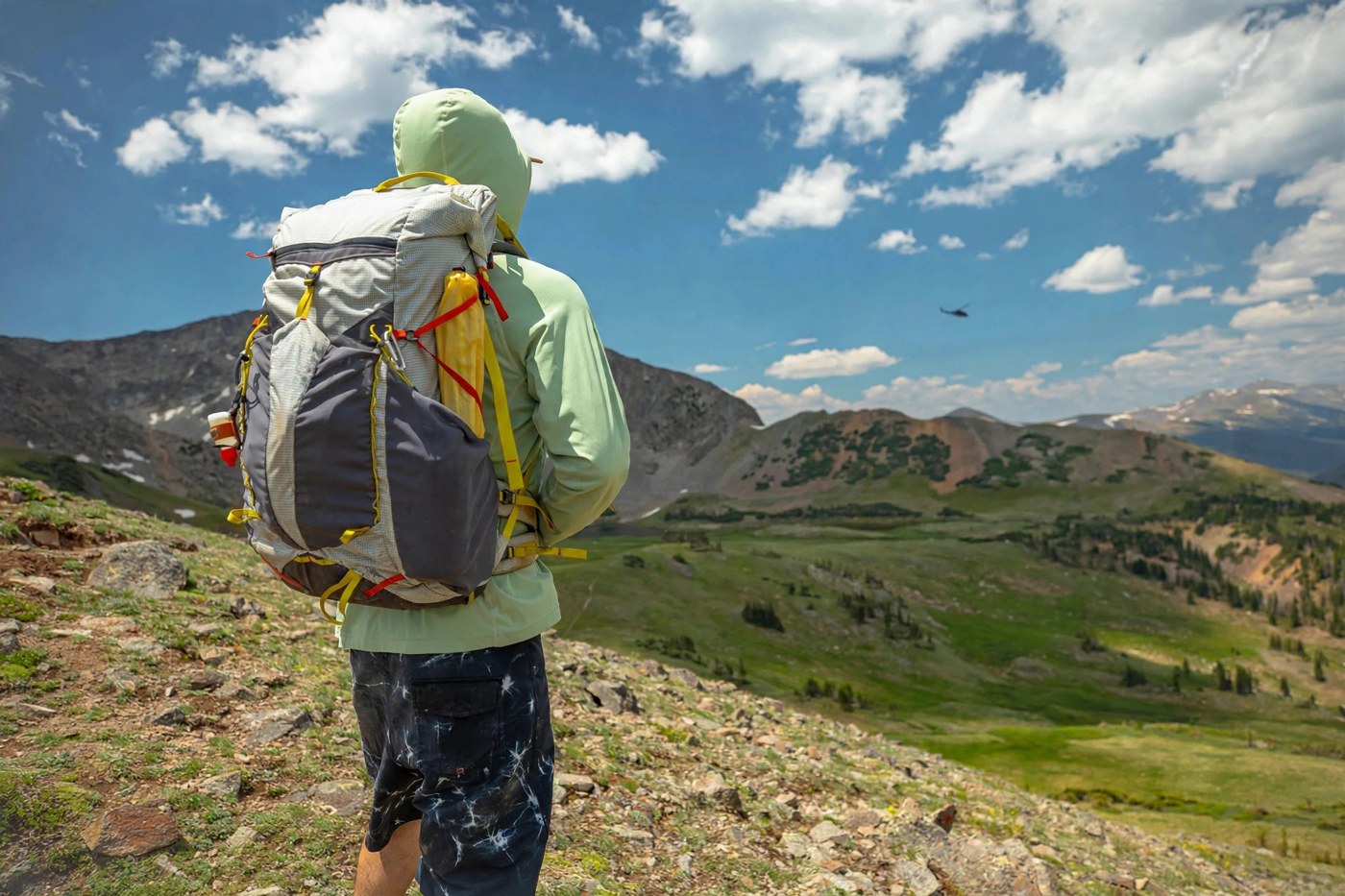
- A 7 L trash pouch that clips to the outside of the pack, so rubbish can be carried out without going inside the main compartment.
04
Fabric and material combinations
The materials split the jobs of abrasion resistance, lightness and comfort.
- Main fabric: high-tenacity nylon with a ripstop grid. A solution-dyed option gets its colour before the yarn is spun. Compare approved physical swatches across fabrics, and verify any recycled-content claim separately.
- Base: a heavy twill fabric where the pack meets the ground.
- Lining: nylon taffeta.
- Side pockets: a non-stretch mesh with an outer layer of stretch, snag-resistant mesh. The double layer keeps the pocket's shape while resisting tears from branches.
- Harness and back panel: stretch fabric on the shoulder straps, hip belt and back panel for comfort against the body.
The useful lesson is material zoning: the toughest fabric where wear happens, lighter fabric elsewhere and soft stretch fabric where the pack touches the wearer.
05
Who is it for?
- Thru-hikers and long-distance backpackers who carry heavier loads for several days.
- Hikers between two sizes, who benefit from the adjustable back panel.
- Style-aware outdoor users who want a pack that looks different from the usual black and grey.
- Hikers who want hardware and closures that are easy to distinguish from the main body.
- Hikers in alpine terrain who need to carry trekking poles or an ice axe on the outside.
06
Pain points it solves
- Poor fit. The height-adjustable lower back panel lets each user fine-tune torso length.
- Digging for gear at the bottom. Full-length back-panel zip access opens the whole main compartment.
- Sore shoulders under load. The aluminium frame and integrated hip belt move weight to the hips.
- Rubbish inside the pack. The external 7 L trash pouch keeps waste separate.
- Torn side pockets. Double-layer mesh resists snags.
- Boring, hard-to-read packs. Structured colour blocking makes adjustment points easy to find and makes the pack easy to spot.
07
Design strengths
- Panel colours distinguish hardware and high-wear areas.
- Adjustable fit within each size.
- Back-panel access to the main compartment.
- Strong feature set for a 50 L pack: hydration sleeve, five types of storage, hip-belt pockets, tool attachments and a trash pouch.
- Ripstop body fabric and a heavier base address different kinds of wear.
- Reasonable weight of 1.39–1.45 kg for a framed, adjustable pack.
08
Limitations to keep in mind
- Light fabric shows dirt. The light grey grid fabric will show stains more than darker packs, although the dark lower panels help.
- Load limit. The recommended maximum of 18.14 kg rules it out for very heavy expedition loads.
- Many features means more parts. Some ultralight hikers may prefer fewer straps and pockets.
09
Choosing between the two sizes
The pack comes in two sizes, and the numbers show how much thought went into the fit.
- Medium suits torso lengths of 46–51 cm and hip measurements of 81–137 cm. It weighs 1.39 kg and measures 84 × 25 × 20 cm.
- Large suits torso lengths of 51–56 cm and hip measurements of 89–147 cm. It weighs 1.45 kg and measures 89 × 24 × 20 cm.
The two torso ranges meet at 51 cm, so there is no gap between sizes. A hiker at the edge of either range can adjust the lower back panel to the end of its travel. The hip-belt ranges are wide and overlap heavily, which means the belt fits most body shapes in either size. The weight difference between the sizes is only 60 g, so choosing the size that fits best costs almost nothing in weight. The 43 cm top opening is wide enough to load a sleeping bag or bear canister without a struggle.
10
Turning a colour plan into production
A colour-blocked pack looks simple in a render, but it is one of the harder designs to produce consistently. Every colour on this pack sits on a different material: grid nylon, plain nylon, heavy twill, mesh, webbing, cord, zip tape and moulded hardware. Each material takes dye differently, so the same colour reference can look slightly different on each one. Good practice in development includes:
- Lab dips for every material. Each fabric, webbing and cord colour should be approved against a physical colour standard under the same light source.
- Agree colour tolerances for each substrate and compare adjacent panels from the same production lot.
- Trim matching. Zip tapes, pullers and buckles often come from different suppliers. Their colours must be checked against the fabrics, not just against a colour card.
- Lot control. Fabric from different dye lots should not be mixed within one order, or neighbouring panels may not match.
- Light versus dark seams. Where a light panel meets a dark one, thread colour should be chosen deliberately so stitching looks clean on both sides.
Getting these details right is what separates a colour-blocked pack that looks premium from one that looks patchy.
11
Design lessons
- Give each colour a role. Use neutral colours for the body and bright colours for the parts users touch.
- Follow the structure. Let colour blocks follow panel seams, so the design looks intentional and is easy to sew.
- Use darker colours where dirt collects. The base and lower sides benefit most.
- Combine looks with fit. A beautiful pack still fails if it does not fit. An adjustable back panel widens the range of users.
12
Development checklist
Record these inputs on the sample brief before approving the layout:
- The full colour plan: body colours, accent colours and where each one goes.
- Physical colour references for each fabric, webbing, cord and zip colour.
- Fabric choice by zone, including any recycled or solution-dyed requirement and certification needed.
- Capacity, target weight, torso range and whether the back panel should be adjustable.
- Frame type, hip belt and harness details.
- Pocket list, attachment points and any extras such as a trash pouch.
Related guide: Choosing a Day-Hiking Pack: Capacity, Carry Systems and Hip Belts
Discuss your bag development project
ANSON XIE
General Manager & Founder
Quanzhou Junkai Pengda Special Equipment Co., Ltd.
Email: ansonxie@jkpdtime.com
Phone: +86 177 5095 3355
WhatsApp: +86 177 5095 3355
Factory address: Floors 2–4, Building 1, Phase I, Huixin Intelligent Manufacturing Industrial Park, Hui'an County, Quanzhou, Fujian, China