
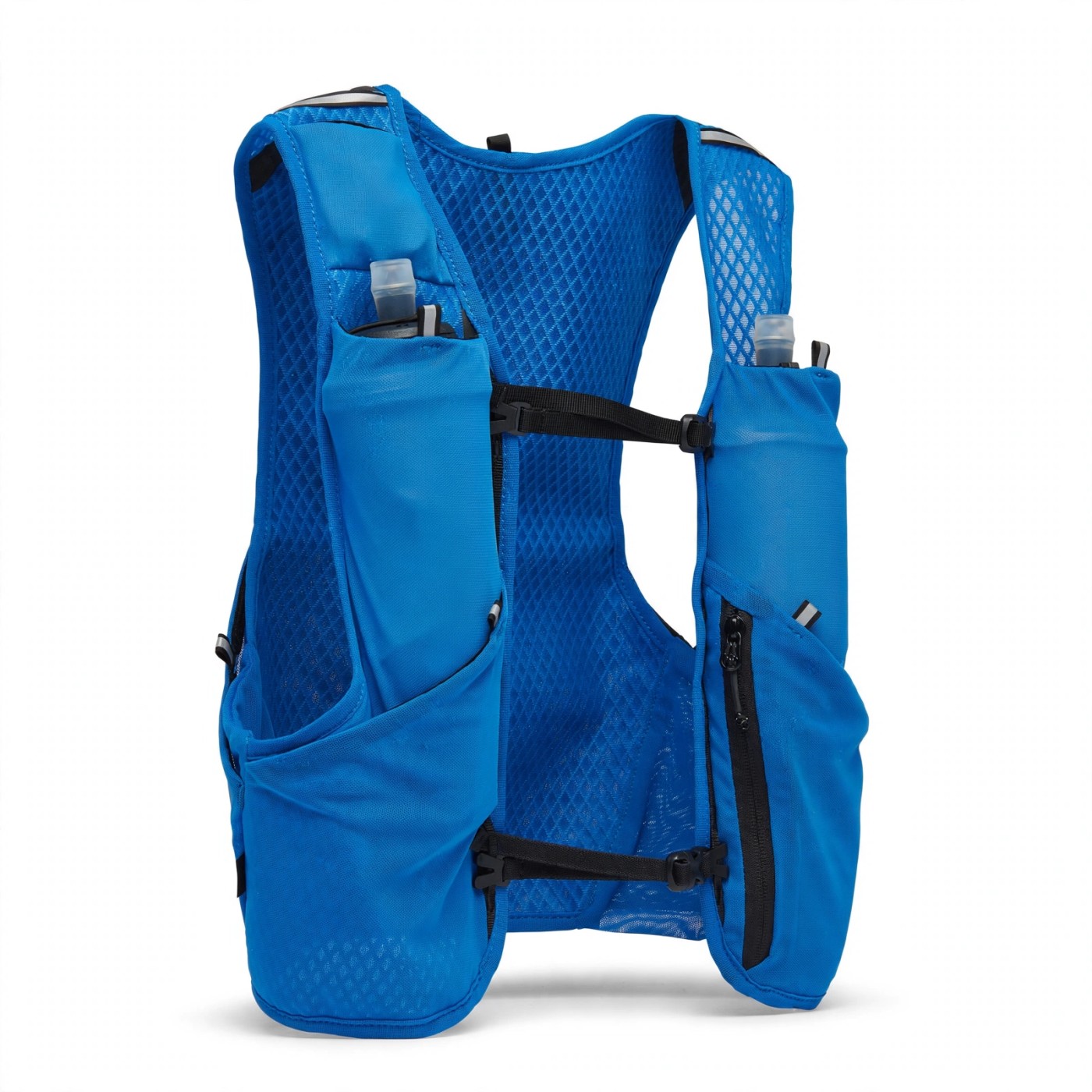
A daily training vest has a different job from a vest sized around a long race kit list. This 4-litre example puts the essentials for regular runs first: front flasks, accessible food and phone storage, and room for a light layer.
01
At a glance
| Feature | 4 L daily training vest |
|---|---|
| Type | Trail running vest, flask-first with reservoir option |
| Capacity | 4 L of gear storage |
| Weight | 200 g |
| Front flask layout | 2 × 500 ml soft flasks |
| Reservoir | Not included; rear sleeve fits a 2 L reservoir |
| Total liquid | 3 L with flasks and reservoir together |
| Sizes | S / M / L, in unisex and women's-specific versions |
| Closure | Two pinch-buckle chest straps on repositionable anchor points |
| Materials | Nylon ripstop with four-way stretch mesh and soft bound edges |
02
Design positioning: the everyday vest
The design question this vest answers is a simple one: what does a runner carry on a normal training day? The answer is usually a litre of water, some food, a phone, keys, and a light jacket for the top of the climb. Four litres holds exactly that, with room for gloves and a headlamp.
The layout stays light by avoiding extra compartments, removable padding and a belt. Most of its capacity is divided between the harness and the back instead of concentrated in a single deep pocket.
The three nominal sizes use two fit profiles. A more streamlined shoulder and chest shape is distinct from simply scaling down a unisex pattern. For someone between sizes, compare the two with the planned flask load.
03
Functions and features
Two flask pockets with elastic collars
The two most important pockets are the flask pockets on the front, one on each side. They hold the two 500 ml soft flasks that come with the vest, and an elastic collar at the top of each pocket keeps the flask in place as the water level drops. Drinking is quick: lift the flask, sip, and put it back.
Flask compatibility depends on the pocket opening and collar. Check an alternative flask when full and partly empty, rather than assuming the same marked capacity gives the same fit.
Stretch mesh pouches above the flasks
Above each flask pocket sits a large stretch mesh pouch. These are the food pockets: gels, bars and chews go in here, within reach of either hand while moving. The pouches are open-topped and elastic, so they hold their contents by stretch rather than by a closure, which keeps them fast but means very small items can work their way out on rough ground. The mesh pouches extend around the sides of the torso, spreading food across the chest and flanks rather than stacking it in one place.
A zip pocket for the phone
One front pocket is different from the rest: a large zip pocket on the left chest that holds a large phone securely. It is the place for the things that must not fall out. A second, smaller zip pocket on the chest holds an emergency card, identification or a key fob, although neither zip pocket is waterproof, so a phone in heavy rain still needs its own protection.
Quick-access side pockets
High-stretch side panels extend from the harness itself, and they carry quick-access side pockets that can be reached without taking the vest off. These hold the things a runner grabs most often on the move: extra food, a small item of clothing, or rubbish from a gel wrapper. A small stash pocket on the right shoulder serves the same purpose for rubbish, and it also anchors the top half of the pole-carry system.
Rear storage split at the midline
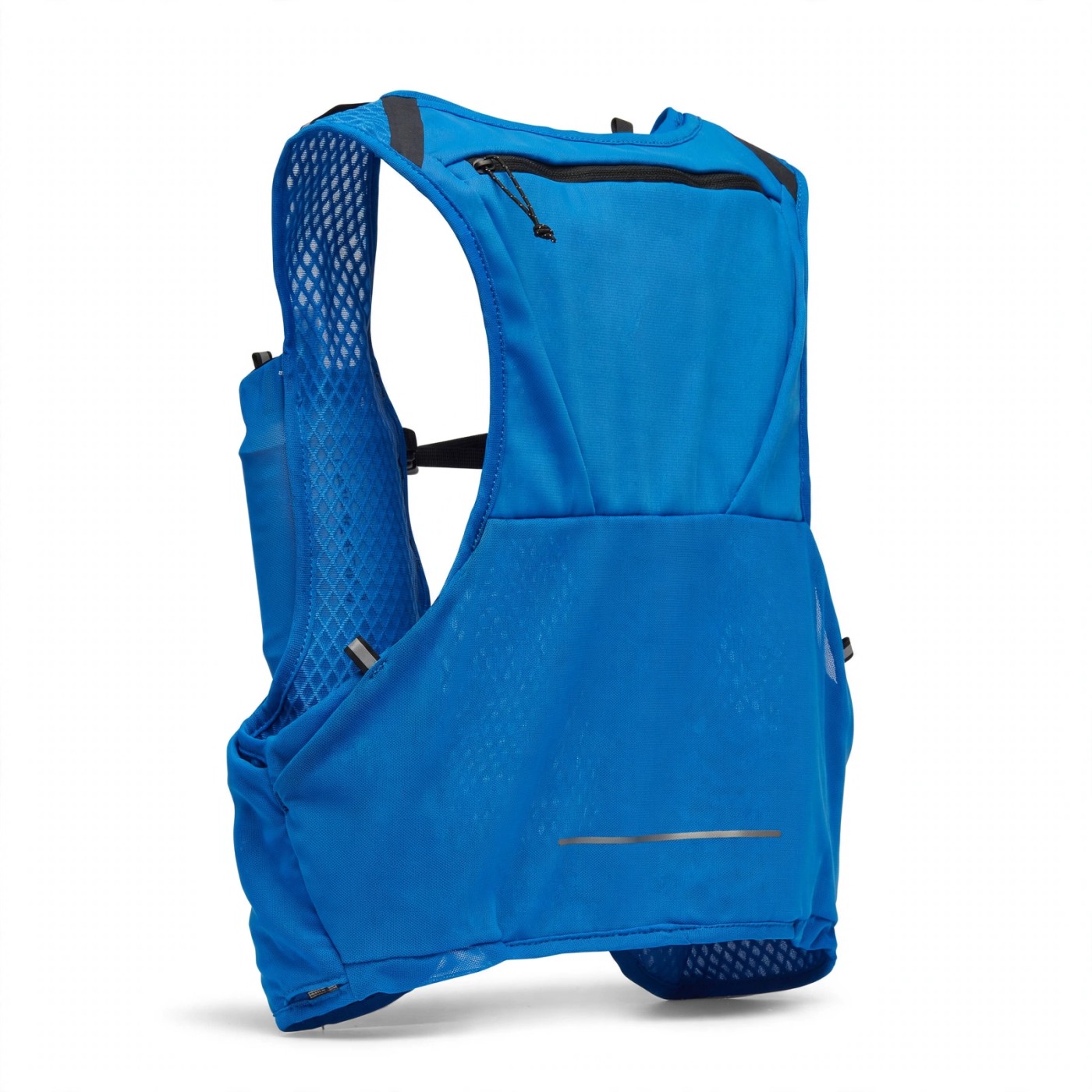
The back divides storage into an upper zip compartment and a lower full-width stretch pocket. Items that need to stay put can go behind the zip; a layer can go into the stretch pocket without taking up space in the closed pocket.
The trade-off is reach. Reserve the full-width rear pocket for layers that can come out at a stop, and use side and front pouches for items needed on the move.
A reservoir sleeve for longer days
Behind the main rear compartment sits a full-length reservoir sleeve that fits a 2 litre reservoir, held by a clip loop so it does not slide down as it empties. The reservoir is not included. With the two flasks and a full reservoir, the vest carries 3 litres of liquid. One limitation is that the sleeve has no insulation, so the first sip on a hot day will be warm, and in freezing weather the hose can chill.
Two pinch-buckle chest straps
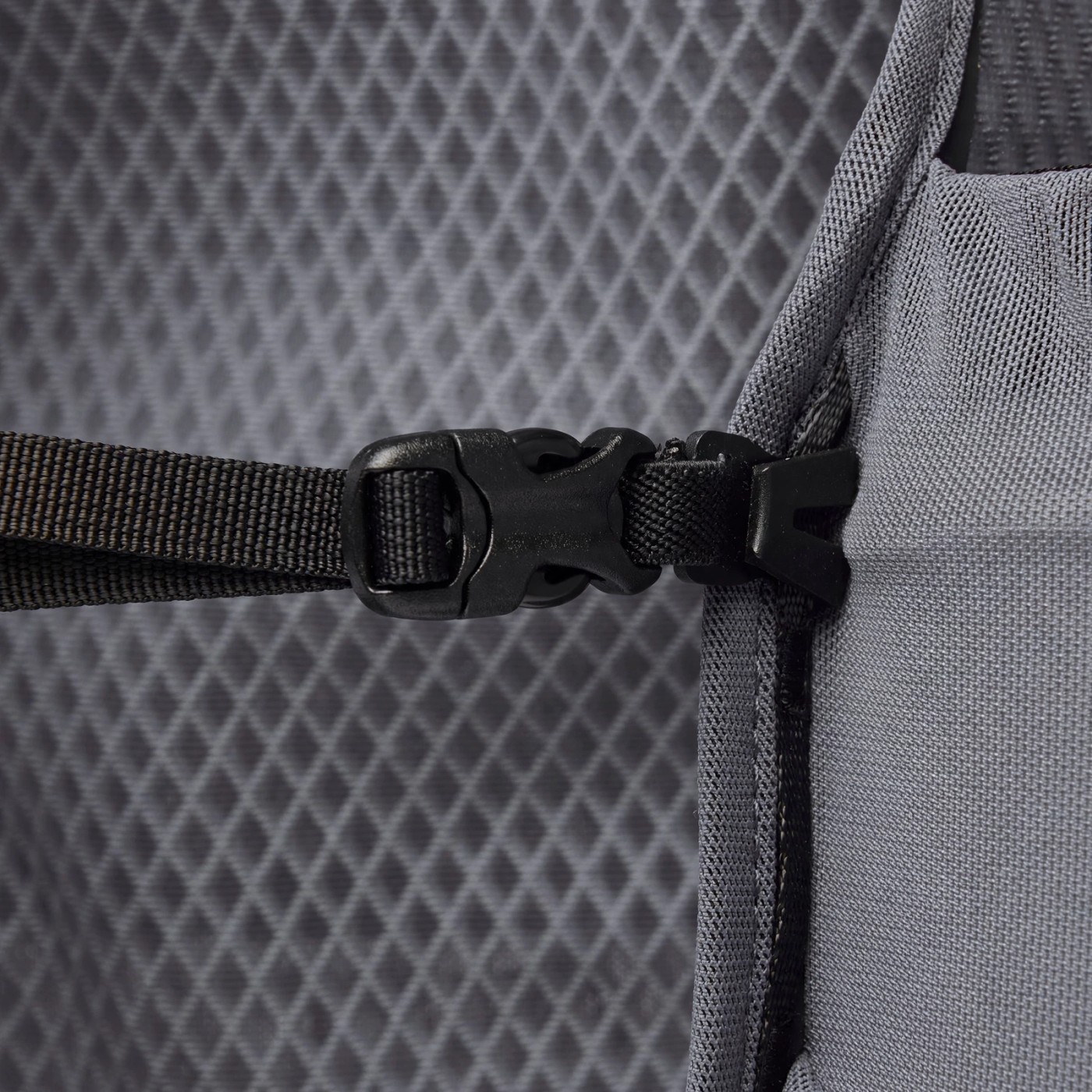
Two thin chest straps close with pinch buckles. Reposition the straps on the side anchors to suit chest height. Check the upper strap under load so that it does not press unnecessarily when breathing or swinging an arm.
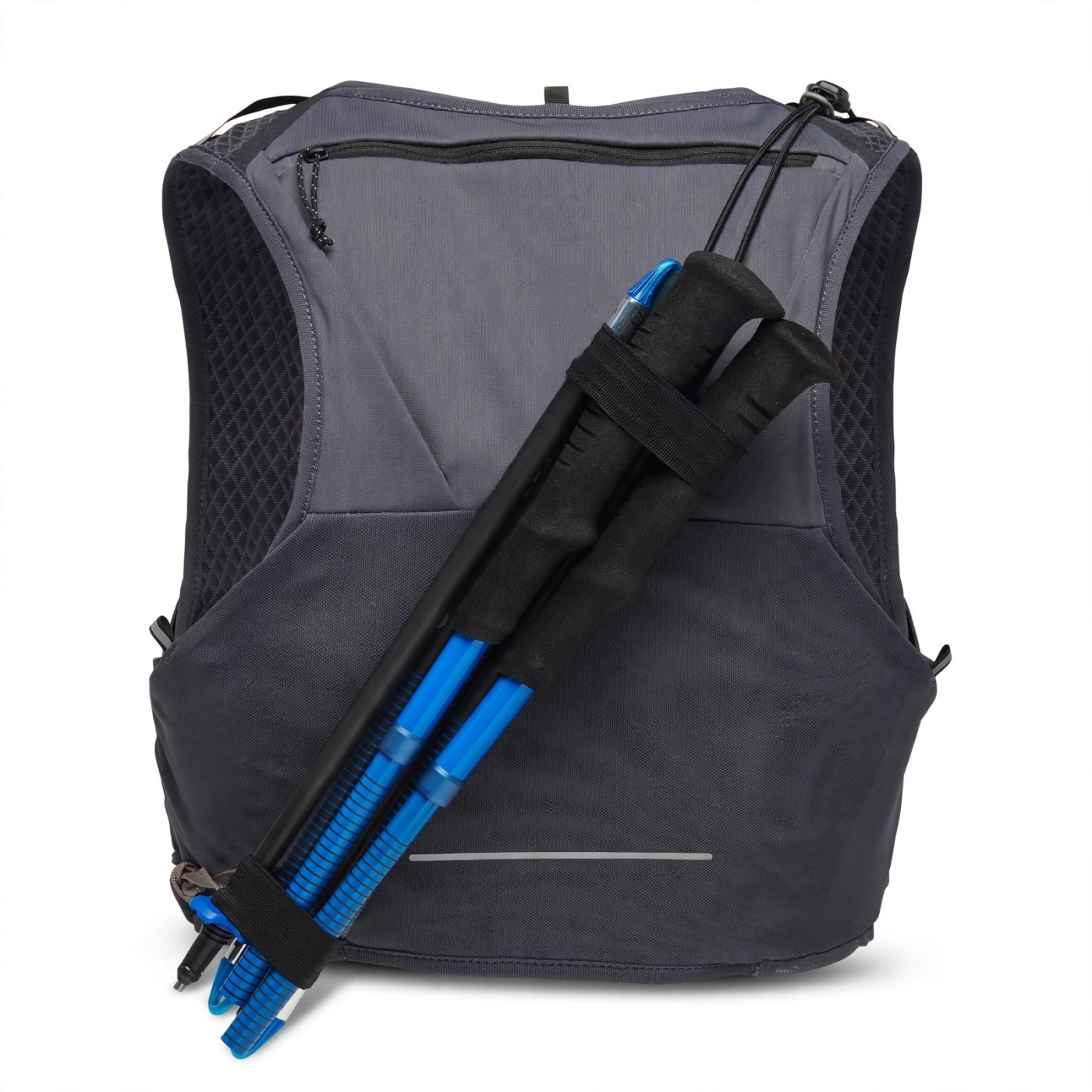
Over-the-shoulder pole carry
Poles are carried diagonally over the shoulder, held by straps at the lower left and upper right of the vest. The idea is that the runner can stow or retrieve the poles without taking the vest off: slide an elastic loop around each end of the folded poles, lift them over the left shoulder and head, and pull a sliding adjuster on the right shoulder to tighten them down. The system is slim and light, and the straps tuck away when not in use. For runners who never carry poles, the system is removable entirely.
Check pole stowage and retrieval with the vest loaded. If the motion is awkward or the poles cross an arm's path, stop to adjust them.
Safety details
A small reflective strip sits low on the rear panel. Check whether a layer or folded poles cover it in the intended carry configuration.
04
Fabric and material combinations
Nylon ripstop. The body uses a lightweight nylon ripstop with a grid intended to limit the spread of a small tear.
The harness and side panels use stretch mesh. The edges have flexible binding. Compare how the binding and mesh move together against the intended clothing layer.
Open-weave back panel. Open mesh leaves passages for air and moisture; the drying time depends on how wet the vest gets and how it is dried.
Care. Check the care instructions before washing and let the vest air dry fully before storing it.
05
Who is it for?
Trail runners who train most days. This is the vest for the daily run, the after-work loop and the weekend long run. Its 4 litre capacity matches what a normal training day needs.
Runners moving from road to trail. A runner who already owns a road vest will find this one familiar in weight and fit, with the added durability and pole carry that trail running demands.
Mountain runners who carry folded poles may benefit from a separate attachment that leaves the front pockets free.
Runners who want a women's-specific fit. The women's version is cut for a narrower shoulder and chest profile rather than simply being a smaller men's vest.
It is less suitable for multi-day trips, where the 4 litre capacity runs out, and for runners who need a reservoir included in the box. It is also not the vest for a runner who wants a single pocket for everything: the storage is deliberately split into many small pockets, and runners who prefer one big compartment will find that fussy.
06
Pain points it solves
A vest that is too much for a normal run. Many ultra vests are built for a 100-mile kit list and feel empty on a 10 km training run. This vest is sized for the run a runner does most often, so it sits close and stable even when it is nearly empty.
Flasks that bounce. The elastic collars on the flask pockets hold the flasks still as they empty, which is the most common complaint about flask vests. Poles that need a separate solution. The over-the-shoulder carry keeps folding poles on the vest and off the hands, and it can be removed entirely for runners who never use poles.
A phone with nowhere safe to go. The large zip pocket on the left chest holds a large phone securely, which is a detail many vests still get wrong.
Heat and moisture at the back. Open mesh keeps more of the contact area free of solid cloth.
07
Design strengths
- Light for its capacity. 200 g for 4 litres of gear plus a litre of water on the chest.
- Built for daily use. The capacity matches a normal training day, so the vest earns its place every day rather than once a season.
- Two fit options. Unisex and women's-specific versions, in three sizes.
- Poles included in the design. An over-the-shoulder carry that is removable and stashable.
- Many small pockets, well placed. Food on the chest, phone in a zip pocket, jacket in a full-width rear pocket.
- Breathable. All-mesh construction with an open-weave back panel.
- Nylon ripstop body. Check the thin shell and binding at pocket openings and other contact points.
08
Limitations to keep in mind
Capacity is limited. Four litres is aimed at day runs rather than multi-day gear.
Flask stability depends on fit. Check whether a substitute flask stays supported as it empties.
Rear pockets are hard to reach on the move. The full-width rear pocket is excellent for a jacket, but reaching it while running is awkward. Use the front and side pockets for anything needed mid-stride.
Pole carry needs practice. Stowing and retrieving poles while running is fiddly, and most runners will want to stop for it. Practise before race day.
The rear sleeve is not insulated. Test the fit of the selected reservoir and plan for water temperature to follow the weather.
09
Design lessons
Size for the everyday run, not the longest run. A vest that matches the daily training load gets used every day.
Split the storage by access, not by volume. Front pockets for food, a zip pocket for the phone, a full-width rear pocket for a jacket: each pocket is defined by when the runner reaches for it.
Make pole carry removable so a runner who doesn't need it can leave the attachment off.
Offer a women's-specific cut as a real cut. Reshaping the shoulders and chest is more work than scaling a men's vest down.
10
Prototype brief
Useful inputs for a daily training vest prototype include:
- Target capacity, target weight and the distances and terrain the vest is designed for.
- Hydration layout: flask pocket size and number, reservoir sleeve size and whether the reservoir is included.
- Size range and the measurement point for each size, and whether a women's-specific cut is needed.
- Fabric choices: ripstop and stretch mesh with real recovery, soft edge binding, buckle types, and reflective positions.
- Pocket list with approximate sizes and opening directions, including a secure pocket for phone and keys.
- Pole carry positions and colour options.
Related guide: Trail Vest Pockets: Where Do Used Gel Wrappers Go?
Discuss your bag development project
ANSON XIE
General Manager & Founder
Quanzhou Junkai Pengda Special Equipment Co., Ltd.
Email: ansonxie@jkpdtime.com
Phone: +86 177 5095 3355
WhatsApp: +86 177 5095 3355
Factory address: Floors 2–4, Building 1, Phase I, Huixin Intelligent Manufacturing Industrial Park, Hui'an County, Quanzhou, Fujian, China